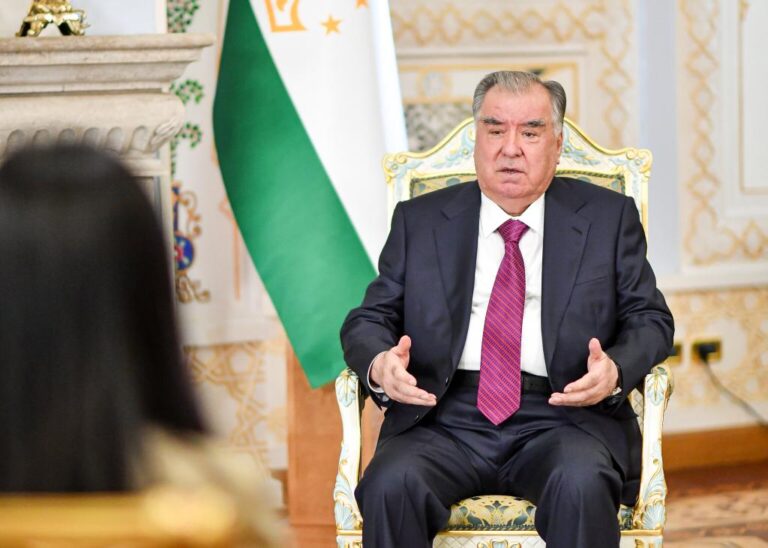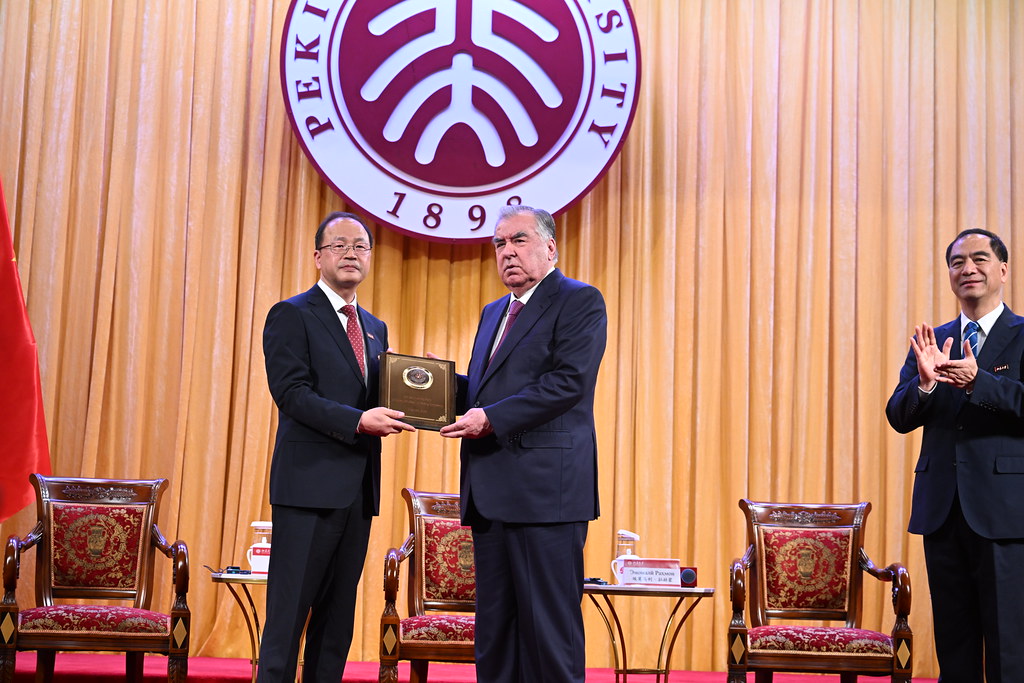
Tajik President Emomali Rahmon has been awarded an honorary professorship by Peking University during a ceremony held on May 12, underscoring expanding academic and people-to-people ties between Tajikistan and China.
According to Chinese media reports, He Guangcai, Chair of the Peking University Council, presented a commemorative plaque, while university President Gong Qihuang handed over the honorary certificate to the Tajik leader.
The university said the honor recognizes Rahmon’s role as a national leader and statesman in strengthening bilateral relations, promoting regional peace and development, and supporting reforms in global and regional governance.
During the ceremony, Rahmon addressed students and faculty at Peking University in Beijing. He noted that since 2005, the university has admitted 47 students from Tajikistan, including six currently studying under Chinese government scholarships.
Peking University (PKU), located in Beijing’s Haidian district, is one of China’s leading public universities under the Ministry of Education.
Founded in 1898 as the Imperial University of Peking by decree of the Guangxu Emperor, it was the country’s first national university. In 1912, it was renamed Peking University following the establishment of the Republic of China. The institution underwent major restructuring in 1952 and later expanded in 2000 through a merger with Beijing Medical University.
Today, Peking University includes eight faculties covering sciences, engineering, humanities, social sciences, economics and management, interdisciplinary studies, and health sciences. It comprises 55 schools and departments, 24 research institutes, and six affiliated hospitals.
Meanwhile, the Tajik president’s official website reports that both sides expressed interest in attracting Tajik youth to study natural sciences, engineering, information technologies, and artificial intelligence at Chinese universities, as well as in increasing the number of educational scholarships for Tajik citizens.
At the proposal of the President of Tajikistan, the leadership of Peking University reprotedly decided to allocate 10 annual scholarships for Tajik students.