Tajikistan will celebrate the 5,500th anniversary of the proto-urban site of Sarazm in 2020. The celebrations will cost Tajikistan at least 7.1 million U.S. dollars (USD).
The celebrations will take place in the Tajik northern city of Panjakent on September 12, 2020.
The organizing committee comprising twenty-two people is led by Prime Minister Qohir Rasoulzoda.
In accordance with the approved plan of events, 605,000 somoni are earmarked for organizing, scientific and cultural events and 220,000 somoni are expected to be spent for events on preparing and holding the celebrations.
Besides, the government earmarks more than 66.4 million somoni for renovation of historical relics of Sarazm, construction of new social and cultural facilities in Panjakent.
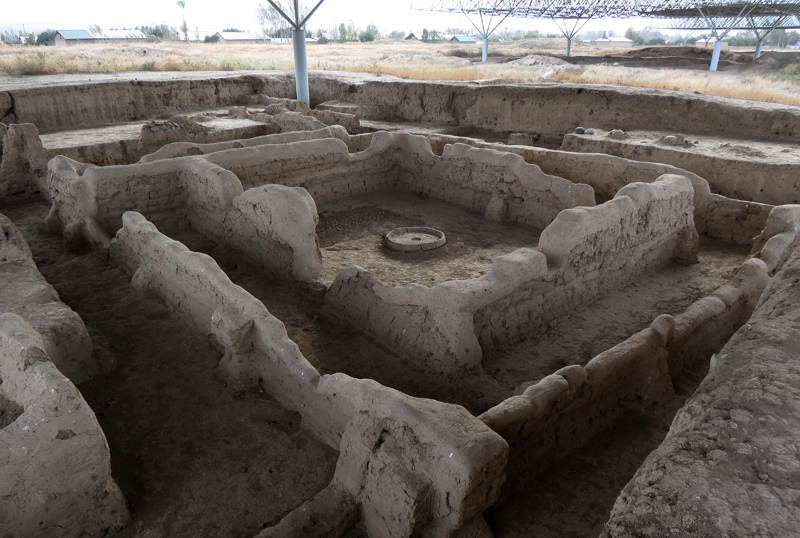
The archaeological site of the ancient city of Sarazm is located in the Zarafshon Valley in the Tajik northern Sughd province. The ancient city of Sarazm is believed to have been founded as a mining point to collect from nearby sources of turquoise. The city also served as an important regional agricultural and copper production center.
Located 15 kilometers west of the city of Panjakent, the site occupies an area of about 1.5 kilometers in length and 400 to 900 meters in width. At the peak of the occupation, the site would have covered an area of up to 90 hectares, 35 of which are unobstructed.
The site is of great interest for archaeologists as it constitutes the first proto-historical agricultural society in this region of Central Asia. Moreover, it is the most north-eastern of those proto-historical agricultural permanent settlements. Sarazm was the first city in Central Asia to maintain economic relations with a network of settlements covering a vast territory from the Turkmenistan steppes and the Aral sea (in the northwest) to the Iranian Plateau and the Indus (in the south and southeast).
Following surface discoveries unearthed due to agricultural activity, the first excavation of the site started in 1977. During that first excavation, eight soundings in the different locations were conducted and three areas were excavated. In 1987, seven areas were excavated and twenty soundings had been conducted.
The site was researched through multiple partnership between the Tajik SSR and international partners. Most notably, a fruitful collaboration between French and Tajik researchers flourished starting in 1984 with a first scientific mission. In 1985, a cooperation agreement was signed between the Centre national de la recherche scientifique (CNRS) and the Tajik Academy of Science for three years, a partnership that would be renewed until 1998, when the French mission changed towards supporting the preservation of the site. Most archeometric analysis were conducted by the CNRS in France. The French mission was supervised by R. Besenval, R. Lyonnet (ceramology) and F. Cesbron (mineralogy).
In 1985, two American professors, P.L. Kohl (Wellesley College) and C.C. Lamberg-Karlovsky (Harvard) took part in an expedition organized as a joint USSR and USA archeological exchange program.
The site is composed of four distinct layers of occupation separated by long period of abandonment. The datation of the layers is uncertain, although most agree on the first half of the 4th millennium BC as the beginning of the occupation. The datation has been established initially through radiocarbon dating.
The proto-urban site of Sarazm was inscribed on the World Heritage List in July 2010 as "an archaeological site bearing testimony to the development of human settlements in Central Asia, from the 4th millennium BCE to the end of the 3rd millennium BC". It is the first World Heritage Site in Tajikistan.