Experts say the Central Asian authorities block news and social networking websites under the pretext of the fight against terrorism.
Blockage of news and social networking websites was the main subject of the 4th Central Asian Internet Governance Forum in Uzbekistan’s capital, Tashkent, from May 15 to May 19.
The main purpose of the Forum was to strengthen the existing public platform for the discussion of policies regarding Internet governance in the Central Asian nations.
The Forum addressed issues related to cyber security, Internet freedom and regulation, development of the DNS industry and access to the Internet as well as global and national approaches to Internet governance.
The Forum participants, in particular, noted that the authorities today, under the auspices of the fight against terrorism, block resources which they just do not like.
Meanwhile, Freedom House’s study, Freedom on the Net 2018, notes that the internet is growing less free around the world, and democracy itself is withering under its influence. Disinformation and propaganda disseminated online have reportedly poisoned the public sphere.
Events in 2018 have confirmed that the internet can be used to disrupt democracies as surely as it can destabilize dictatorships, according to the report.
The report says China was once again the worst abuser of internet freedom in 2018.
The study assessed 65 countries around the globe, covering 87 percent of the world’s internet users.
Of the 65 countries assessed, 26 have reportedly been on an overall decline since June 2017, compared with 19 that registered net improvements.
In almost half of the countries where internet freedom declined, the reductions were related to elections.
The report notes that Internet freedom in Kazakhstan and Uzbekistan remained “Not Free” in 2018.
In Kazakhstan, new legal amendments reportedly further restricted online anonymity and a court recognized an opposition movement as extremist.
Despite improved affordability, speeds, and internet access, the internet is heavily regulated by the country’s authoritarian government. Authorities regularly block websites and employ the legal system to stifle free expression online. Kazakhstan is also developing a complex infrastructure to control internet traffic, the study notes.
According to the report, the internet freedom environment in Uzbekistan remains repressive, though there has been a slight opening of the online media environment and some Voice over Internet Protocol (VoIP) platforms became available in May 2018.
Nearly half of the population in Uzbekistan reportedly had internet access in 2018, with growing mobile penetration playing a critical role in improving access. However, expensive service, low broadband speeds, and limits on data continue to curb internet use. The state controls the country's international internet gateways through the state-owned telecommunications operator Uztelecom. Some VoIP services such as Skype, WhatsApp, and Viber were unblocked in May 2018, after being inaccessible during the majority of the reporting period.
Kyrgyzstan is the only nation in the Central Asian region where is no total blockage of of the news and social networking websites.
Freedom on the Net 2018 ranks Kyrgyzstan where Internet freedom is “Partly Free.”
According to the study, Internet freedom in Kyrgyzstan declined in 2018, driven by the government’s arbitrary blocking of an increasing number of websites under anti-extremism rules.
Despite some improvements, a rural-urban divide in internet access persists, and internet penetration rates lag behind those of neighboring countries, says the report.
As far as Tajikistan and Turkmenistan are concerned, they were not included in the study.
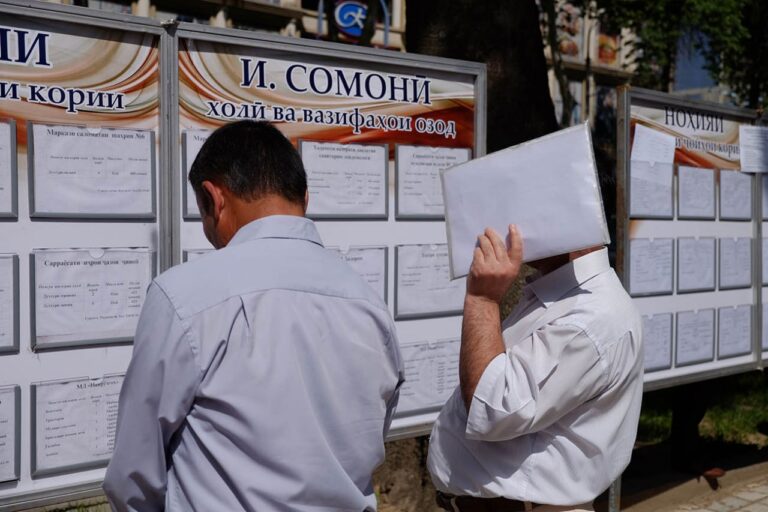
In Tajikistan, the authorities block news and social networking sites without any explanations already a year.
According to specialists, the main reasons for blocking access to the websites are emergency situations, activation of the opposition in social networks and public discontent with government’s decisions.
Early this month, many popular websites in Tajikistan were down, hours after the head of state expressed fears about the spread of terrorist ideas online.
Twitter, Facebook, Instagram, and other social media platforms stopped working. Google services began experiencing blocks early this month as well.
The site of Asia-Plus news agency has remained blocked for already half a year for unknown reasons. All mobile operators say the site has been blocked beyond them.
The communications service agency says that the Unified Electronic Communications Switching Center did not block access to the Asia-Plus’s website.