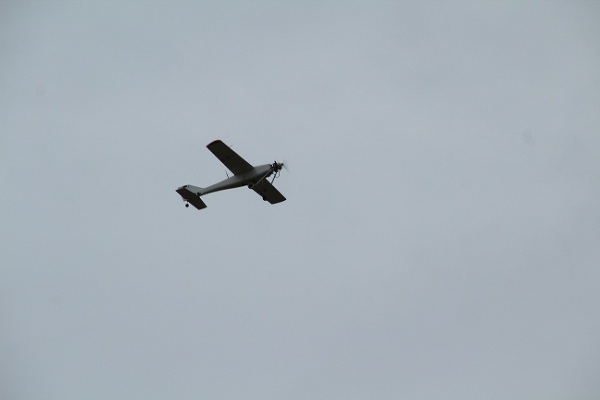
Tajik-made drones demonstrated in Dushanbe on the sidelines of international conference

Tajik-made drones (unmanned aerial vehicles) have been demonstrated in Dushanbe on the sidelines of an international conference on remote monitoring and technologies of use of unmanned aerial vehicles, according to Tajik state-run news agency Khovar.   The international scientific-and-practical conference formally tilled “The Remote Monitoring and Technologies of Use of the Unmanned Aerial Vehicles” reportedly began […]

Tajik-made drones (unmanned aerial vehicles) have been demonstrated in Dushanbe on the sidelines of an international conference on remote monitoring and technologies of use of unmanned aerial vehicles, according to Tajik state-run news agency Khovar.  

The international scientific-and-practical conference formally tilled “The Remote Monitoring and Technologies of Use of the Unmanned Aerial Vehicles” reportedly began at the Academy of Sciences in Dushanbe on May 23 and continued at the airfield in the Jomi district of the Khatlon province on May 24.

Two types of drones produced by the Tajik-Chinese Joint Research Center for Use of Unmanned Aerial Vehicles — the electric-powered drone and the gasoline-powered drone – have been tested at the airfield in the Jomi district.   .

In the Central Asian region, only Tajikistan uses the unmanned aerial vehicles for scientific and research purposes, the President of the Academy of Sciences of Tajikistan, Farhod Rahimi, noted.
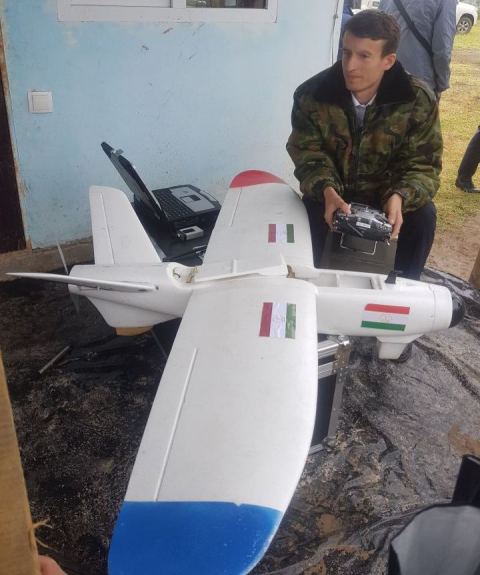
The drones were reportedly operated by Tajik specialists who had taken training courses in China.   

According to the Vice-President of the Academy of Sciences of Tajikistan, Abdusattor Saidov, the Academy’s technological park now has several drones.  

“In Tajikistan, drones can be used to monitor disaster-prone areas as well as natural ecosystems and human impacts on the ecosystem,” Saidov said.  

An unmanned aerial vehicle (UAV), commonly known as a drone, is an aircraft without a human pilot on board.  UAVs are a component of an unmanned aircraft system (UAS); which include a UAV, a ground-based controller, and a system of communications between the two.  The flight of UAVs may operate with various degrees of autonomy: either under remote control by a human operator or autonomously by onboard computers.

Compared to crewed aircraft, UAVs were originally used for missions too "dull, dirty or dangerous"[4] for humans.  While they originated mostly in military applications, their use is rapidly expanding to commercial, scientific, recreational, agricultural, and other applications, such as policing, peacekeeping, and surveillance, product deliveries, aerial photography, and drone racing. 

Join us on social media!

Article translations:

Related Article

Tenisi
Оби зулол
Оби зулол

Most Read

Коммерсбонк Точикистон

Recent Articles

RZD announces the restoration of passenger services between Moscow and Dushanbe

Direct rail services between the capitals of Russia and Tajikistan were suspended in March 2020 due to the COVID-19 pandemic.

#AP30/Stories. “Selam! Heller nichek?” How Tatars live today in Sughd province

On the 30th anniversary of "Asia-Plus," we continue to publish reports that remain relevant even after years. This story was told in 2021, and since then, little has changed in the life of the Tatar community in Tajikistan.

15,000 cameras, drones, and robots: how technology monitors pilgrims in Mecca and Medina

During Hajj 2026, Mecca and Medina were under unprecedented digital control.

Another child in Dushanbe removed from family and sent to boarding school

The Ministry of Internal Affairs reports that the parents did not pay adequate attention to the child.

Emomali Rahmon instructs to address issues in seed production following criticism of the industry

Issues have been noted with certification, seed quality, and the material and technical base of the industry.

Water, climate, and a $130 billion deficit: seven key outcomes of the Water Conference in Dushanbe

At the forum, countries and international organizations discussed new mechanisms for cooperation, investments, and technologies that are essential for addressing the global water crisis.

Eskhata Bank introduces a new generation children’s wallet

"Eshkata Bank" has created a full-fledged digital platform that helps children aged 7 to 16 learn how to manage money.