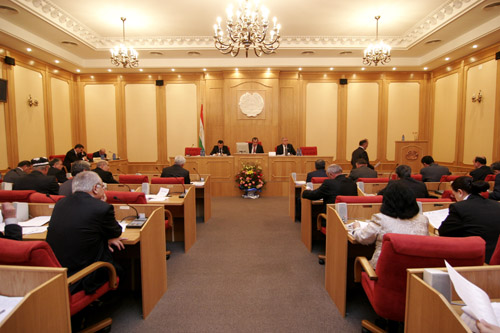
The next, 19th session of Tajikistan’s upper house (Majlisi Milli) of parliament (Majlisi Oli), presided over by its head, Mahmadsaid Ubaidulloyev, will take place in Dushanbe on June 12.
A source in the Tajik government says the session will consider twenty-six laws adopted by the Majlisi Namoyandagon (Tajikistan’s lower chamber of parliament).
Besides, Majlisi Milli members will decide the questions of replacement of six judges of the country’s Supreme, Constitutional and High Economic Courts, the source added.
Under the country’s Constitution, the powers of the Majlisi Milli include: formation and abolition, and change of administrative-territorial units; the election and recall of the chairman, deputy chairmen, and judges of the Constitutional Court, Supreme Court, and High Economic Court upon the recommendation of the President; decide questions of the repeal of inviolability of the chairman, deputy chairmen, and judges of the Constitutional Court, Supreme Court, and High Economic Court; giving consent to the appointment and relieving of the Procurator General and his deputies; and the effectuation of other powers to be determined by the Constitution and by laws.
The laws adopted by the Majlisi Namoyandagon are submitted to the Majlisi Milli, with the exception of the Law on the State budget. The Majlisi Milli seconds the law by a majority of votes of the total number of its members.
The most important law submitted for consideration to the Majli Milli is the legislation on martial law, which was adopted by the Majlisi Namoyandagon on May 29.
Recall, the legislation on martial law, in particular, permits the government to limit the free dissemination of information, ban the purchase and sale of arms and to stop people from either entering or leaving the country. The president needs parliament’s approval to impose martial law
On May 29, the Majlisi Namoyandagon also endorsed amendments made to the country’s law on the military intelligence of the armed forces of Tajikistan that enable intelligence agents to operate within the country.
Officials said these laws are needed to protect the nation at times of war and against the threat of terrorist sleeper cells.