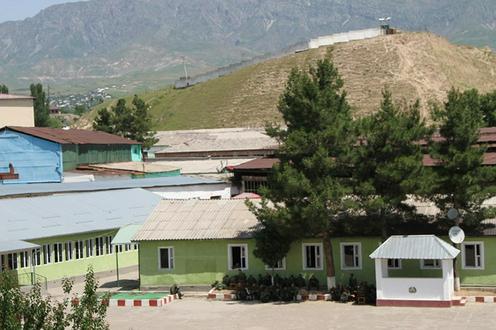
The Supreme Court of Tajikistan has begun considering criminal proceedings instituted against 28 prison inmates who are accused of leading a riot at Vahdat’s high-security penal colony, Shermuhammad Shohiyon, the head of the Supreme Court, told reporters in Dushanbe on July 22.
According to him, the criminal proceedings instituted against employees of Vahdat’s penal colony have not yet moved to the Supreme Court.
Recall, a statement released by the Justice Ministry on May 20 said five of the inmates were killed by fellow prisoners in the unrest while 24 rioters were liquidated and 35 others were detained during the authorities' measures to quell the riot.
In a statement, the ministry said that the clashes started when some 30 inmates convicted of membership in various militant groups killed three prison guards. The ministry said the inmates were armed with knives and other sharp objects.
They then allegedly turned their attention to their antagonists among the rest of the prison population.
In order to intimidate the other prisoners, the Islamic State members executed five people and ten others were savagely beaten, the statement said.
Among those said to have been executed by the rioters were Said Qiyomiddin Ghozi, also known as Eshoni Qiyomiddin, and Sattor Karimov, also known as Makhsumi Abdusattor.
Said Qiyomidin Ghozi was an active member of the Islamic Renascence Party of Tajikistan and he was sentenced to 25 years in prison in 2018.
Sattor Karimov was member of the IRPT Presidium and he was sentenced to 28 years in prison in 2016.
The rioters also executed Saidmahdikhon Sattorov, also known as Shaikh Temour, a mullah and self-styled “prophet of the end of the world” who was sentenced to 16 years in jail on July 8, 2015 on an array of counts, including extortion, polygamy and defiling corpses.
The Islamic State (IS) terror group has claimed responsibility for a May 20 prison riot at Vahdat’s penal colony.
The militant group said on June 14 in its online Al-Nabaa publication that the "attackers” at the maximum-security prison about 15 kilometers east of Dushanbe were “caliphate soldiers" – a term that IS has used in the past to claim responsibility for terrorist attacks around the world. The IS publication did not provide evidence to support its claim.