



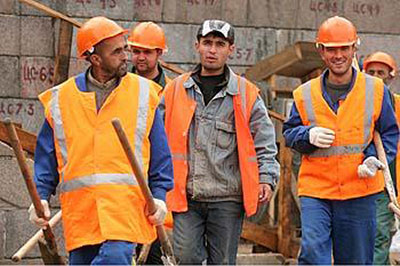
After some reduction in recent years, labor migration from Tajikistan has reportedly increased this year.
Over the first seven months of this year, more than 357,000 citizens of Tajikistan had left the country to work abroad, which was 27 percent more than in the same period last year, according to the Monitoring and Early Warning Report, monthly report for August 2019.
In July this year, some 57,000 people had left the country seeking better employment opportunities, which was 26.7 percent more than in July of 2018.
The report authors attribute the increase in the labor migration from Tajikistan to a certain improvement of conditions of labor for migrants in the Russian Federation.
Last year, labor migration from Tajikistan reportedly reduced approximately 10 percent.
Meanwhile, Russian media reports, citing the Russian Border Service, say 524,000 Tajik national have arrived in the Russian Federation over the first sx months of this year for seasonal work.
According to various sources, more than 1 million Tajik nationals arew currently living and working in Russia.
The UN Committee on the Protection of the Rights of All Migrant Workers and Members of their Families on April 4 this year concluded its consideration of the second periodic report of Tajikistan on measures taken to implement the International Convention on the Protection of the Rights of All Migrant Workers and Members of Their Families.
Presenting the report, Tajik chief prosecutor Yusuf Rahmon said that the national plan of action on the implementation of the Universal Periodic Review 2017-2020 provided for the development of a national strategy for the promotion and protection of human rights to 2025. One of its priorities was the protection of the rights of migrant workers, especially children. The national development strategy 2020-2030 aimed to, inter alia, improve the productivity and employment of the population and develop legal and social frameworks for labor migration. Bilateral agreements had been signed with Kazakhstan, the United Arab Emirates and Qatar. Over the last 12 months, more than 484,000 Tajiks had reportedly left the country to work abroad; the main destination countries remained Russia, for 96 percent of the workers, and Kazakhstan for 3.0 percent of them. During the same period, over 424,000 citizens had returned from working abroad. Tajikistan had taken up the Committee’s recommendation concerning the regulation of recruitment companies, even if only a small fraction of the Tajik citizens used their services. The pre-departure training of citizens had increased; in 2018 alone, more than 53,000 citizens had taken the national programs and training activities which helped them find jobs abroad.
Currently, there are reportedly 15 state-run and private recruitment companies organizing the sending of Tajik citizens to work abroad.







