Sections of the Dushanbe-Kulma highway in the Gorno Badakhshan Autonomous Region (GBAO) will rehabilitated gradually in three stages.
Taking into consideration the difficult geographic terrain we will rehabilitate roads in GBAO gradually in three stages: 1) Qalaikhumb-Vanj-Rushan Border section; 2) Rushan-Khorog section; and 3) Khorog-Kulma-China Border, Tajik Minister of Economic Development and Trade Nematullo Hikmatullozoda told lawmakers on October 15.
According to him, the first phase of the Dushanbe-Kulma highway rehabilitation reconstruction project included rehabilitation of Dushanbe-Danghara, Shkev-Zighar, Shagon-Zighar, and Shamsiddin Shohin – Zighar sections of the highway as well as rehabilitation of the Murgab-Kulma-China Border section.
Besides, two tunnels – Khatlon and Istiqlol – were built, the minister said.
The Ministry of Transport (MoT) says an estimated budget for rehabilitation of the 163-kilomters Rushan-Khorog highway is 200 million U.S. dollars and 567 million U.S. dollars will be needed for rehabilitation of the 395-kilometer Khorog-Kulma highway.
Recall, the Government of China is issuing a non-repayable grant of 218,000 U.S. dollars for conducting feasibility study for rehabilitation of some key sections of the highway connecting Dushanbe and Kulma Pass on the border between the Gorno-Badakhshan Autonomous Region of Tajikistan and the Xinjiang Autonomous Region (XUAR) of China, which is part of the second stage of the Dushanbe-Kulma highway rehabilitation reconstruction project.
It is to be noted that expenses related to conducting the project feasibility study amount to 1.56 million yuan (equivalent to more than 218,227 U.S. dollars) and will be covered by the non-repayable grant provided for by a government-to-government agreement on technical and economic cooperation signed by Tajikistan and China in 2018.
According to a MoT, it is about conducting the feasibility study for rehabilitation of the Qalaikhumb-Vanj-Rushan District Border road, which is 92.3 kilometers in length.
The project aimed at rehabilitating this section of the Dushanbe-Kulma highway reportedly provides for construction of two tunnels with a total length of 5.2 kilometer, several galleries with a total length of 490 meters, 15 meters with a total length of 634 meters and some other facilities.
Frist Deputy Minister of Transport, Suhrob Mirzozoda, had earlier told Asia-Plus that Beijing will award a grant of 230 million U.S. dollars for rehabilitation of this section of the highway.
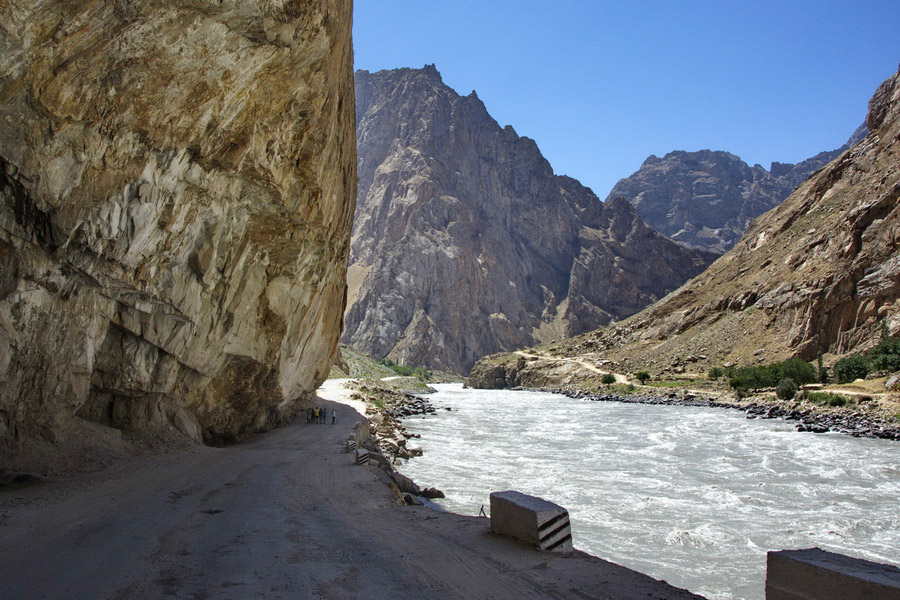
The Dushanbe-Khorog highway is a road running for nearly 700 kilometers and the route goes through picturesque mountainous regions of Pamir. Due to the harsh mountain climate, road conditions in many places are bad. Distance from Dushanbe to Qalaikhumb, administrative center of GBAO’s Darvoz district, is some 370 kilometers and the most part of this road is in a very good condition. Meanwhile, the piece of the road from Qalaikhumb to Khorog is in a poor condition.