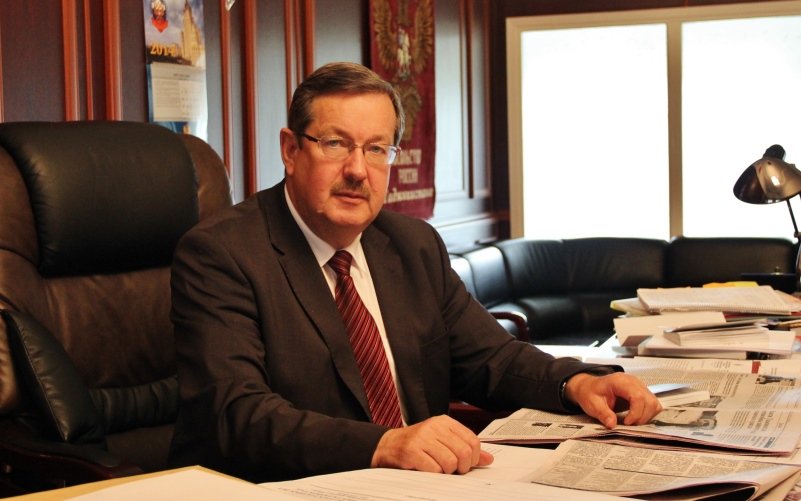
Bilateral relations between Russia and Tajikistan have developed over the outgoing year dynamically in all fields at both the bilateral and multilateral levels, Russian Ambassador to Tajikistan Igor Lyakin-Frolov told Asia-Plus in an interview.
“I would like to especially note the high level of political dialogue between the two countries,” Russian diplomat said.
According to him, the bilateral trade cooperation between the Russian Federation and Tajikistan had a positive momentum in 2019.
“Over the first eleven months of this year, a two-ay trade between Russia and Tajikistan has valued at 953 million U.S. dollars and we expected that the bilateral trade between our countries will exceed 1 billion U.S. dollars,” Ambassador Lyakin-Frolov noted.
Asked about the possibility of Tajikistan’s joining the Eurasian Economic Union (EAEU), Russia diplomat said, “Accession to the EAEU is a responsible step.”
“As you know, Tajik authorities are carefully studying the experience the Union member nations, especially the neighboring Kyrgyzstan, which is faced with similar social and economic problems.”
According to him, Kyrgyzstan gross domestic product (GDP) has risen, its trade with the EAEU member nations has developed and Kyrgyz migrants working in Russia have actually been equated to Russian nationals in terms of labor.”
“Today, all sectors of Kyrgyzstan’s economy provide the country’s economic growth and growth rates by sectors are above the EAEU average rates due to opportunities opened up for Kyrgyz business to operate freely within the Eurasian economic space,” Ambassador Lyakin-Frolov said.
The Eurasian Economic Union (EAEU) is an economic union of states located primarily in northern Eurasia. A treaty aiming for the establishment of the EAEU was signed on May 29, 2014 by the leaders of Belarus, Kazakhstan and Russia, and came into force on January 1, 2015. Treaties aiming for Armenia's and Kyrgyzstan's accession to the Eurasian Economic Union were signed on October 9 and December 23, 2014, respectively. Armenia's accession treaty came into force on January 2, 2015. Kyrgyzstan's accession treaty came into effect on August 6, 2015.
The Eurasian Economic Union has an integrated single market of 183 million people and a gross domestic product of over 4 trillion U.S. dollars. The EEU introduces the free movement of goods, capital, services and people and provides for common transport, agriculture and energy policies, with provisions for a single currency and greater integration in the future.
The Union operates through supranational and intergovernmental institutions. The Supreme Eurasian Economic Council is the “Supreme Body” of the Union, consisting of the Heads of the Member States. The other supranational institutions are the Eurasian Commission (the executive body), the Eurasian Intergovernmental Council (consisting of the Prime Ministers of member states) and the Court of the EEU (the judicial body).