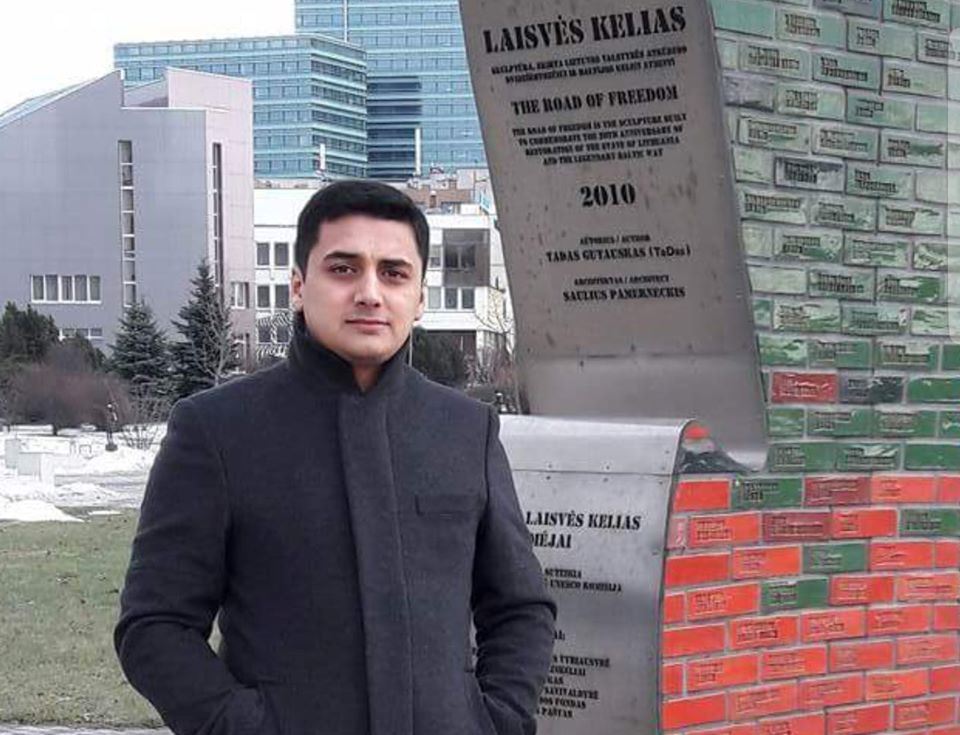
Amnestied former member of Tajik opposition organization Group 24, Sobir Valiyev, has returned to Tajikistan. He thanked his friends for helping him to return to homeland.
Former member of Tajik opposition organization Group 24 also deputy head of the Congress of Constructive Forces of Tajikistan, Sobir Valiyev, noted on his Facebook page on February 20 that he has returned to homeland.
He also noted that he had been amnestied
Valiyev had been charged with public calls to extremist activity (Article 307 (1) of Tajikistan’s Penal Code) and organizing extremist group (Article 307 (2) of Tajikistan’s Penal Code).
In a letter released on February 20, the Interior Ministry of Tajikistan reports his pardon.
Valiyev notes on his Facebook page that he has returned to Tajikistan voluntarily under support of the Interior Ministry Criminal Investigation Directorate.
Recall, Sobir Valiyev, was detained by Moldovan migration police on August 11, 2015 at the Chisinau airport before boarding a flight to Istanbul at the request of Tajik authorities on August 11, 2015. The Chisinau court, however, ruled to release him.
The founding leader of Group 24 Umarali Quvvatov once had close ties with President Emomali Rahmon’s relatives but became an opponent. He fled Tajikistan for Moscow in the summer of 2012. There he formed an organization called Group 24, which he claims is a new political movement opposed to incumbent President Rahmon. He was wanted by Dushanbe on fraud charges that he said were politically motivated.
Quvvatov stayed in Russia and the United Arab Emirates before moving to Turkey. On December 19, 2014, Umarali Quvvatov was arrested in Istanbul for visa violations, but he was released on February 3, 2015. Umarali Quvvatov was shot dead by unidentified assailant in Istanbul, Turkey on March 5, 2015.
Quvvatov’s cousin and business associate Sharofiddin Gadoyev was elected new leader of Group 24 on March 12, 2015.
Tajikistan’s Supreme Court banned Group 24 on October 9, 2014 following growing government pressure on the opposition group after it used the Internet to call for street protests in the capital, Dushanbe, on October 10, 2014.
Supreme Court judge Salomat Hakimova ruled that Group 24 is an extremist organization, and therefore, it is banned in Tajikistan. Its website and printed materials were also banned.
After the split in Group 24, Gadoyev created a new movement in the Netherlands called “Reforms and Development in Tajikistan.” He said at the time that his new movement's goal was to establish a "free and democratic society in Tajikistan."
The movement became member of the National Alliance of Tajikistan, which is led Muhiddin Kabiri, the chairman of the banned Islamic Renaissance Party of Tajikistan (IRPT).
The National Alliance of Tajikistan is an opposition coalition consisting of four Tajik dissident parties and organizations: the Forum of Tajik Freethinkers, the Islamic Renaissance Party of Tajikistan (IRPT), the Association of Central Asian Migrants, and the People's Movement "Reforms and Development in Tajikistan".
The Alliance reportedly represents a broad section of Tajik society, including secular and traditional figures, and is based in Poland.
In February 2019, former members of the opposition movement Group 24, who returned to Tajikistan, asked the Tajik authorities to remove the organization from the extremist organizations list. They said the organization does not pose threat to Tajikistan’s security anymore.