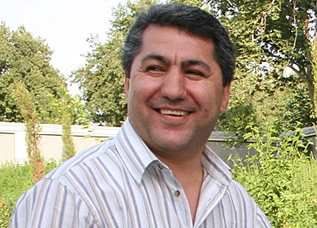
Tajik authorities are reportedly conducting negotiations with countries of the European Union on detention and extradition of Muhiddin Kabiri, leader of the banned Islamic Renaissance Party of Tajikistan (IRPT).
Tajik chief prosecutor Yusuf Rahmon remarked this today while addressing the last session of Tajikistan’s upper chamber (Majlisi Milli) of parliament (Majlisi Oli).
“We are conducting intensive negotiations with countries of the European Union on detention and extradition of IRPT leader Muhiddin Kabiri to Dushanbe,” Rahmon said.
Muhiddin Kabiri became the IRPT's leader after in August 2006 after the death of Said Abdullo Nuri, a signatory to the 1997 peace accord on behalf of the opposition. Before it was banned by the government, the IRPT was the second-largest political party in Tajikistan, with around 40,000 officially registered members. However, it had steadily been losing prominence: In Tajikistan's March 2015 parliamentary elections, the IRPT lost its last two seats in parliament and its last government posts.
In June 2015, the party had its registration taken away and when the Deputy Defense Minister Abdulhalim Nazarzoda rebelled in early September 2015, Tajik authorities connected Nazarzoda to IRPT.
The party was banned in September 2015 and not long after declared an extremist group.
The IRPT was the only registered Islamic party in Central Asia. The IRPT spoke against radical Islamic groups in Afghanistan and Pakistan, in Iraq and Syria.
In 2017, Tajikistan amended legislation to allow courts to try and sentence suspects in absentia. Kabiri's trial in absentia started in February 2018 (Kabiri left the country in March 2015). In the closed-door proceedings, he reportedly faced 16 charges, including inciting racial, national, regional, or religious hatred and plotting the violent overthrow of the government.
Tajikistan's Supreme Court found Kabiri guilty in early October 2018 and sentenced him to a lengthy prison term. Information about just how long the prison sentence was, and of what charges Kabiri was found guilty, was not made public.