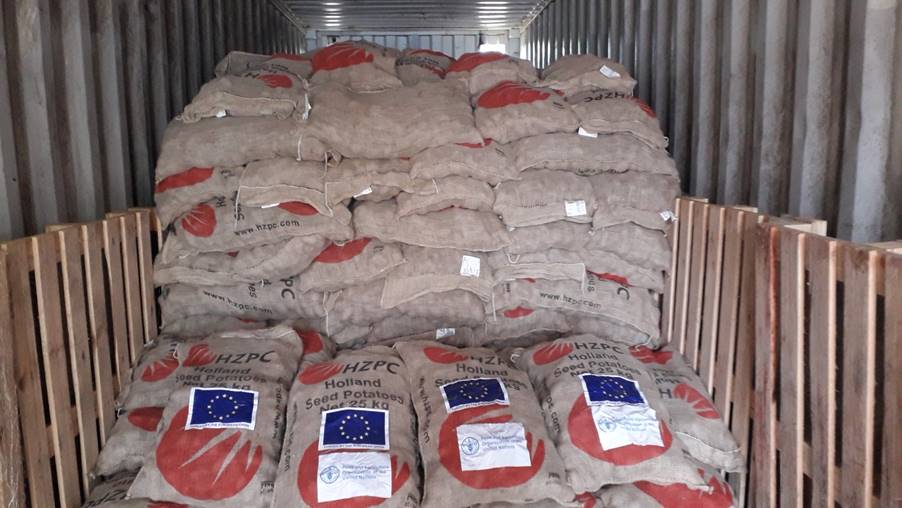
Today, the Food and Agriculture Organization of the United Nations (FAO) concluded the distribution of 60 tonnes of high quality potato seeds to two farmer cooperative unions as part of a European Union-funded project in Tajikistan. The activity helps building small producers’ capacity and improve their livelihoods in northern Shahristan and central Nurobod districts. FAO anticipates to deliver a total of 80 tonnes of elite potato seed to farmers, with an expected output of 1000 tonnes in the upcoming agricultural season.
Seed potato value chains in Tajikistan are experiencing multiple challenges, such as of poor quality, hampered import supply due to COVID-19, combined with increased seed demand ahead of the planting season. Also the availability of quality potato seeds is limited and they usually come at a high price; in addition, access to pesticides, fertilizers and other inputs, prevent farmers from obtaining a higher return.
The cooperative unions that received Red Scarlet potato seeds from the Netherlands, have over 120 farmers as members. As they promote potato seed banks, local farmers will have an opportunity to learn about innovative approaches for producing potato seeds and will be introduced to the GLOBAL GAP system – a voluntary food safety standard.
“We support private seed production through cooperative development. Cooperatives should become a staple element in the potato seed production chain, enabling farmers to own and control, on a democratic basis, business enterprises procuring their supplies and services, and marketing their products,” said Oleg Guchgeldiyev, FAO Representative in Tajikistan. “This, together with further integrating seed production into the private sector, would benefit cooperative members in the long term.”
The European Union Head of Delegation, Ambassador Josefson, pointed out that this initiative forms part of the EU’s response to address the social-economic impact that the global COVID-19 pandemic has on Tajikistan. The distribution of high yield potato seeds for small-scale farmers will on the one side, increase the productivity of the potato value chain; on the other side, the potatoes produced will be available for local consumption, therefore improve food security of rural populations
The EU-funded project is supporting Tajikistan’s agriculture reform programme, which aims to foster farmers’ economic and social growth, and support; it also encourages the development and establishment of effective and efficient cooperative unions. This, in turn, could lead to national structures that represent the interests of their shareholders at all levels of agricultural management.
GLOBAL GAP is a voluntary food safety standard required by many supermarket chains in Europe. These standards are relevant to farmers as they cover the agricultural production process, from inputs to the farm gate.