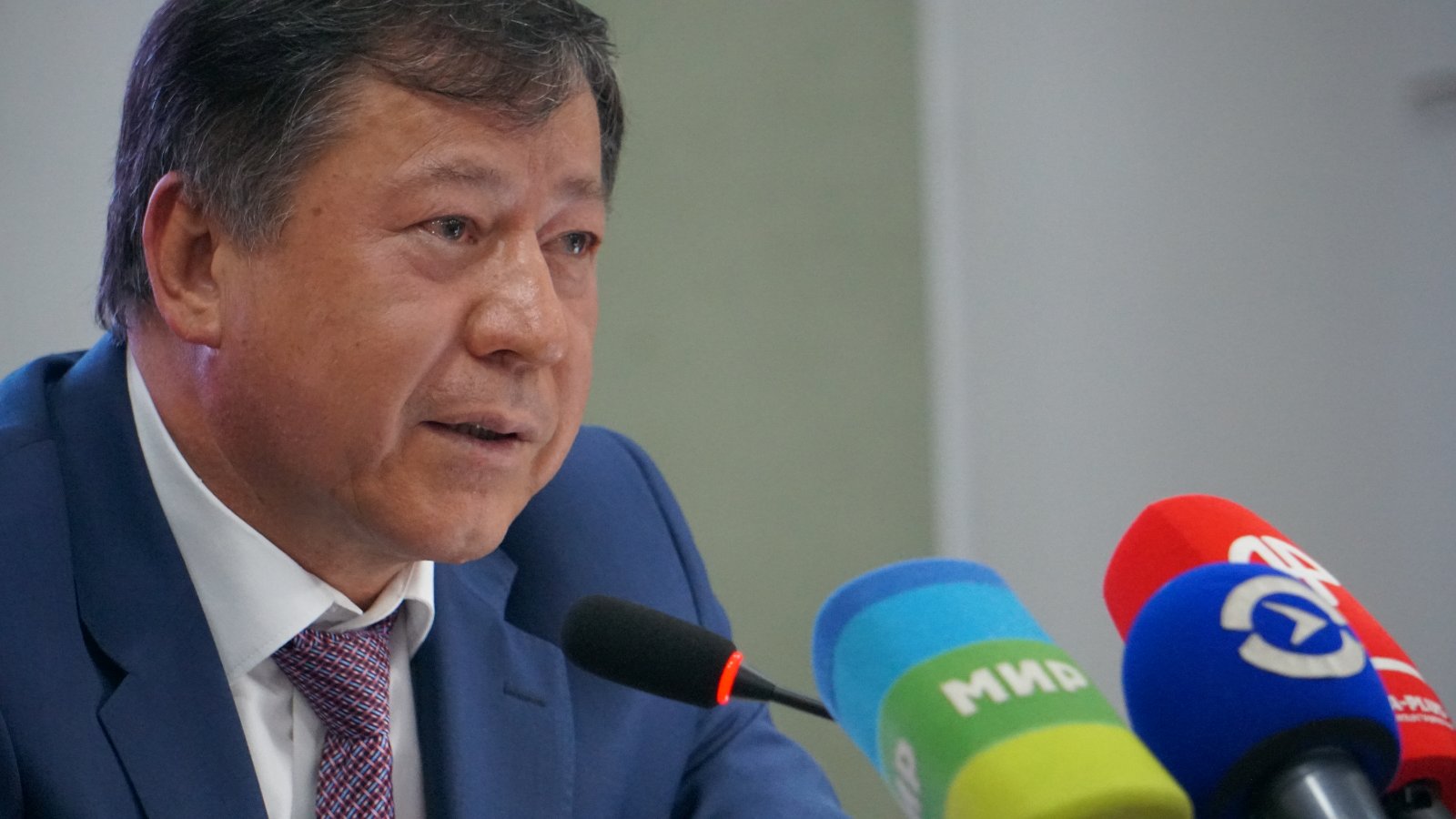
Tajik Interior Minister Ramazon Rahimzoda today denied a report that Tajikistan allegedly extradited an Iranian opposition activist Jamdshid Sharmahd to Tehran as absolutely unfounded.
“Like you, we learned about this from the media. I can say with confidence that Tajikistan has not extradited anyone to Iran over the first six months of this year,” Rahimzoda told reporters in Dushanbe on August 3.
He further noted that some 5,000 nationals of Tajikistan had been put on international wanted list. “To-date, some 1,000 of the have been detained,” the minister said.
Recall, Iran on August 1 said it had detained an Iranian-American leader of a little-known, California-based opposition group known as Tondar for allegedly planning a 2008 attack on a mosque that killed 14 people and wounded over 200 others.
In a statement on its website, the group mentioned an “abduction” of Sharmahd. According to the group's website, Sharmahd is an Iranian-German electronics engineer born in Tehran in 1955 who had lived in Germany before moving to Los Angeles in 2003.
Meanwhile, the Iranian Intelligence Ministry told on Saturday that Jamshid Sharmahd was arrested in Iran. The remark was made after Persian-speaking media outside Iran accused the ministry of abducting Sharmahd in a neighboring country.
“The surveillance of the unknown soldiers of Imam Zaman (Iranian intelligence forces) on a terrorist group based in the United States.has led to the arrest of this terrorist group’s ringleader,” ISNA reported on Saturday August 1.
The Islamic Republic of Iran Broadcasting (IRIB — an Iranian state-controlled media corporation which holds a monopoly of domestic radio and television services in Iran) reports that the ringleader, Jamshid Sharmahd, who headed an armed act of sabotage in Iran, is now in custody of Iran’s intelligence forces.
According to the report, Sharmahd was behind the 2008 terrorist attack that killed 14 people and wounded 215 others at the Hosseynieh Seyed al-Shohada Mosque in the city of Shiraz.
In recent years, Tondar terror group has been planning to carry out a number of big terrorist operations in Iran, it added.
The revolutionary guards' IRGC Intelligence Organization however contradicts the Iranian Intelligence Ministry on the arrest of Jamshid Sharmahd.
IRGC-linked newspaper Javan in Tehran reported Sunday morning that Sharmahd was arrested in Tajikistan and was subsequently handed over to Iran.
A U.S. State Department spokeswoman told Reuters that the U.S. government was "aware of reports” of Sharmahd’s detention.
“The Iranian regime has a long history of detaining Iranians and foreign nationals on spurious charges. We urge Iran to be fully transparent and abide by all international legal standards,” the spokeswoman said.
According to The New York Times, the California-based group’s founder disappeared in the mid-2000s.
Mr. Sharmahd reportedly last appeared in an online livestream video on December 29, according to his group’s website, speaking in Farsi while sitting in a black chair in front of a black background.
“We are not only seeking the liberation of the homeland, but we are also moving toward a special direction, and that is to be Iranian,” Mr. Sharmahd said at one point in the video. “Because we have heard that once upon a time some people were living in the region who were able to build an empire.”
The Kingdom Assembly is overshadowed by other exiled opposition groups. But Iran reportedly brought up the group multiple times while negotiating the terms of the 2015 deal, in which Tehran agreed to limit its enrichment of uranium in exchange for the lifting of economic sanctions.
The opposition royalist group known as the Kingdom Assembly of Iran, known in Farsi as Anjoman-e Padeshahi-e Iran, or Tondar (Farsi for thunder), seeks to restore Iran's monarchy, which ended when the fatally ill Shah Mohammad Reza Pahlavi fled the country in 1979 just before its Islamic Revolution.
Based in Los Angeles, Tondar says it aims to overthrow the Islamic republic and reestablish a monarchy similar to that of Cyrus the Great. It runs pro-Iranian opposition radio and television stations abroad, as well as social media channels.