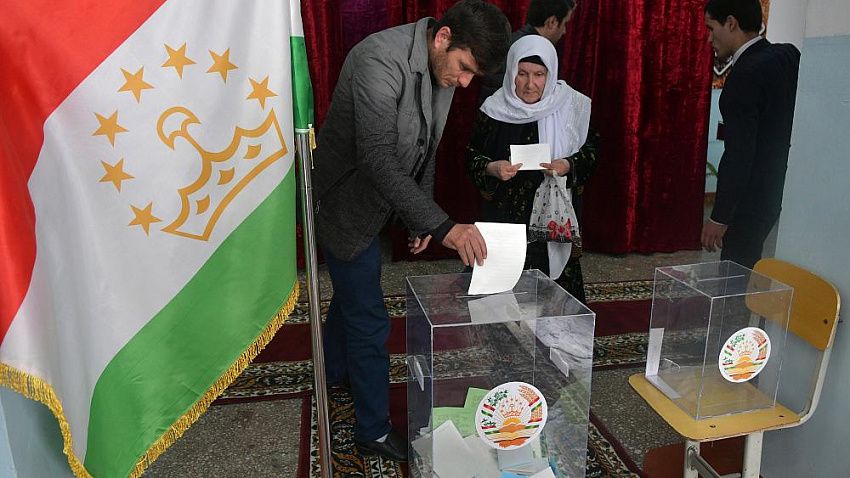
A joint session of both chambers of parliament that took place today has set the date for this year’s presidential election in Tajikistan.
The session, presided over by Malisi Milli (Tajikistan’s upper house of parliament) Speaker Rustam Emomali, has made a decision to hold this year’s presidential election in Tajikistan on October 11, 2020.
Now, political parties and trade unions of the Gorno Badakhshan Autonomous Region (GBAO), Sughd and Khatlon provinces as well as Dushanbe may nominate their candidates for presidency.
The previous presidential election took place in Tajikistan on November 6, 2013.
Recall, amendments made to the country’s law on election of the president, in particular, provide for lowering the minimum age to run for president from 35 to 30.
These amendments are based on constitutional amendments adopted in May 2016. The most important changes included: amending Article 65 to remove term limits on the incumbent President Emomali Rahmon, who owns the status of the “Leader of the Nation”; lowering the minimum age to run for president and for parliament’s upper house (Majlisi Milli) from 35 to 30; and banning political parties based on religious platforms. On a practical level, incumbent President Emomali Rahmon would be allowed to run for re-election indefinitely under the changes. The reduction in minimum age to run for president allows Rahmon's son Rustam Emomali to run for president, because he would be 33 at the end of his father's current term.
According to official figures, the changes were approved by 96.6% of voters. Voter turnout was claimed to be 92%.
The President of Tajikistan is elected for a term of seven years using the two-round system; if no candidate receives over 50% of the vote, a second round is held between 15 and 31 days later between the top two candidates. Voter turnout must exceed 50% for the result to be validated; if it falls below the threshold, fresh elections will be held.
Candidates are required to gather and submit signatures from 5% of registered voters in order to run in the elections.
Emomali Rahmon, who is in power since 1992, may seek a new term in office. It is speculated that his son Rustam Emomali or a close ally could run if he does not.
No election in Tajikistan has been judged as free and fair since its independence from the Soviet Union.