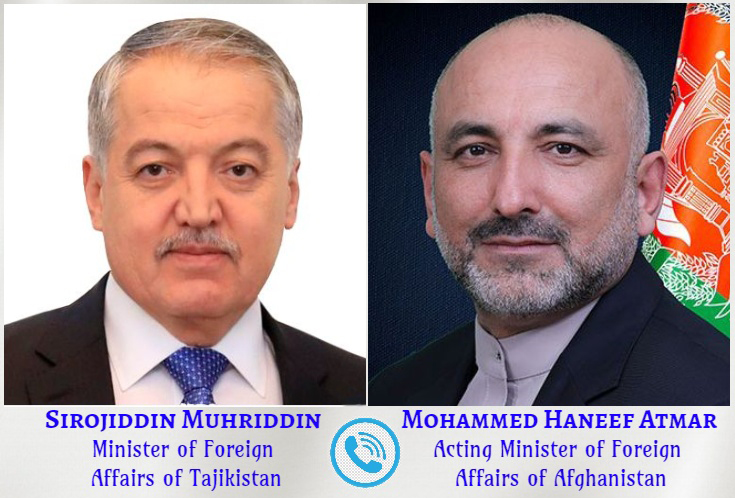
On Thursday August 20, Tajik Foreign Minister Sirojddin Muhriddin had a phone conversation with acting Minister of Foreign Affairs of Afghanistan, Mohammed Haneef Atmar.
According to the Tajik MFA information department, Muhriddin and Atmar discussed plans for the near future.
The two, in particular, discussed the current situation in Afghanistan, peace process in that country and issues related to further expansion of mutual beneficial bilateral cooperation between Tajikistan and Afghanistan.
They reportedly also discussed a number of international and regional issues being of mutual interest.
Mohammad Haneef Atmar (born September 10, 1968) is the current acting Minister of Foreign Affairs and a former Interior Minister of Afghanistan. He was removed from the Ministry of Interior Affairs by Hamid Karzai in the wake of attacks on the June 2010 Afghan Peace Jirga. Before that he worked with several international humanitarian organizations and served as Minister of Rural Rehabilitation and Development and Minister of Education. In 2011, he was part of the Right and Justice party. During his time in office, he has visited several countries to get funding to stabilize Afghanistan. Atmar served as the National Security Advisor to Ashraf Ghani from 2014 to 2018, when he resigned due to disagreement with Ghani on certain issues. In late 2018, Atmar announced his candidacy for the April 2019 presidential elections, indicating he firmly believes a peace deal with the Taliban is possible. He later withdrew his candidature. In April 2020, he was appointed as the foreign minister.
Atmar was born in 1968 as son of Mohammad Asef Atmar in Laghman Province of Afghanistan. He is an ethnic Pashtun. As a young adult, he reportedly worked for the KHAD, an Afghan security and intelligence agency with strong ties to the Soviet KGB, including with a special-operations unit. During the Soviet–Afghan War he fought against Mujahids, and lost a leg defending Jalalabad in 1987. Atmar left for the United Kingdom after the fall of Kabul.
In the UK he earned two degrees at the University of York: a diploma in Information Technology and Computers, and an M.A. in Public Policy, International Relations and Post-war Reconstruction studies, which he studied for from 1996 to 1997. He speaks fluent Pashto, Dari, English, Urdu, and Hindi. In 1992 Atmar began advising on Afghanistan and Pakistan for humanitarian agencies, which he would continue for two years. Following that he went to the Norwegian Church Aid, where he served as Program Manager for six years until 2001. That same year he was hired as the Deputy Director General of the International Rescue Committee for Afghanistan, but after the September 11th attacks, the 2001 U.S. invasion of Afghanistan, and the Bonn Agreement creating an Afghan Transitional Authority under Hamid Karzai, Atmar left to join the new government.