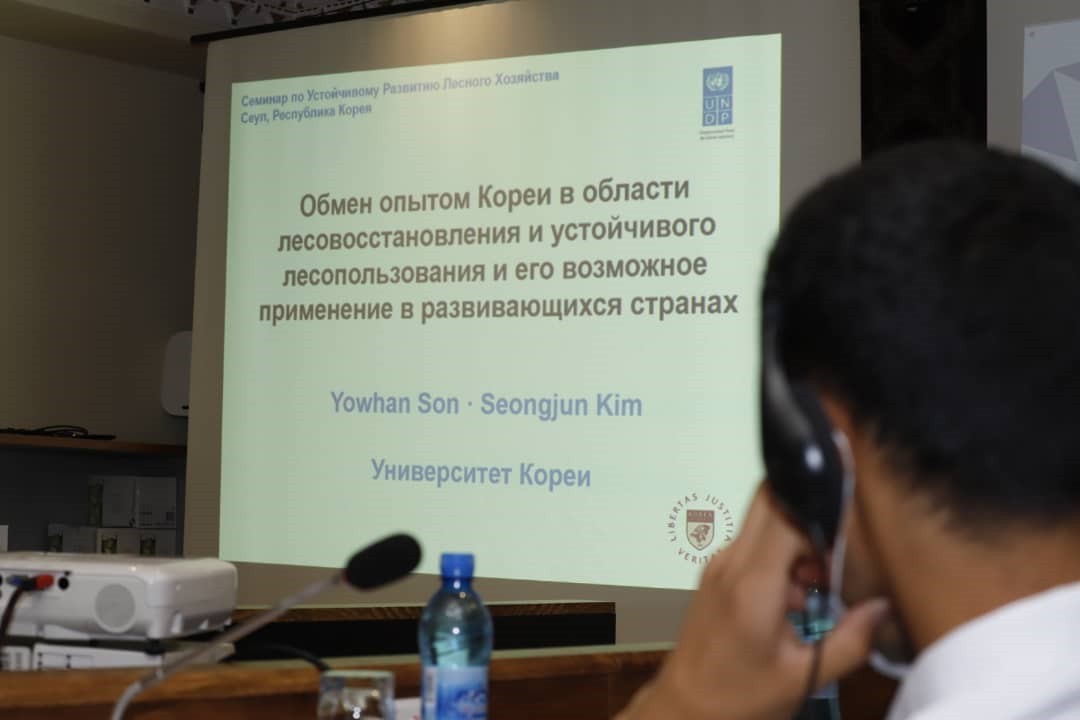
UNDP Tajikistan in collaboration with UNDP Seoul Policy Center (USPC) and the Government of Tajikistan conducted a one-day web-based workshop on August 14 to share best practices and experiences in reforestation and sustainable forest management, and discuss its possible contextualization in Tajikistan.
The web-based workshop was organized as part of USPC’s ‘SDG Partnerships” program’ that is facilitating global knowledge exchange in various forms of innovative and tested-and-proven policy solutions in several thematic areas with a close link to concrete development challenges in partner countries.
The webinar reportedly gathered leading policymakers, practitioners, and national governments officials, notably the agencies in charge of hydrometeorology, forestry, statistics and emergency situations and civil defense.
Given the importance of the sustainable use and conservation of forestry land in accelerating and sustaining pro-poor economic growth in Tajikistan, there is an imminent need to acquire a better understanding of the benefits of forestry and sustainable forestry management approaches in the context of climate change.
UNDP Tajikistan through this project strived to demonstrate the net economic benefits of sustainable forest management and to support future evidence-based policy making, at times where forests are endangered and cover only 3% of the total geography of the country.
Korea’s case study provides a useful reference point for Tajikistan to validate the hidden long-term benefits of disaster risk reduction (DRR) by forestation. The Republic of Korea is one of the four countries and the only (former) developing country that has a successful history of forest rehabilitation after World War II.
During the workshop, the participants received knowledge and information on valuation of reforestation in terms of DRR based on the Korean experience, which promises to make positive impact on sustainable forest management in Tajikistan. Main presentations were made by Dr. Yowhan Son, Department of Environmental Science and Ecological Engineering, Korea University, and Dr. Sarwat Chowdhury, Policy Specialist at UNDP Seoul Policy Centre.
Next steps for this program will include conducting a comprehensive research on valuation of reforestation in terms of climate-induced disaster risk reduction and developing policy recommendation to support the mainstreaming of disaster risk reduction linkages into the national planning and budgeting processes. It is expected that the partnership and triangular cooperation will deepen engagement and encourage further discussion amongst the two countries.