Tajikistan is expected to receive financial assistance from the European Union (EU) for implementation of the healthcare development program.
Tajik President Emomali Rahmon in late December ordered the First Deputy Prime Minister Davlatali Said to sign a relevant agreement with the European Union.
The Ministry of Foreign Affairs reportedly undertakes to agree on the date and place of signing the mentioned agreement.
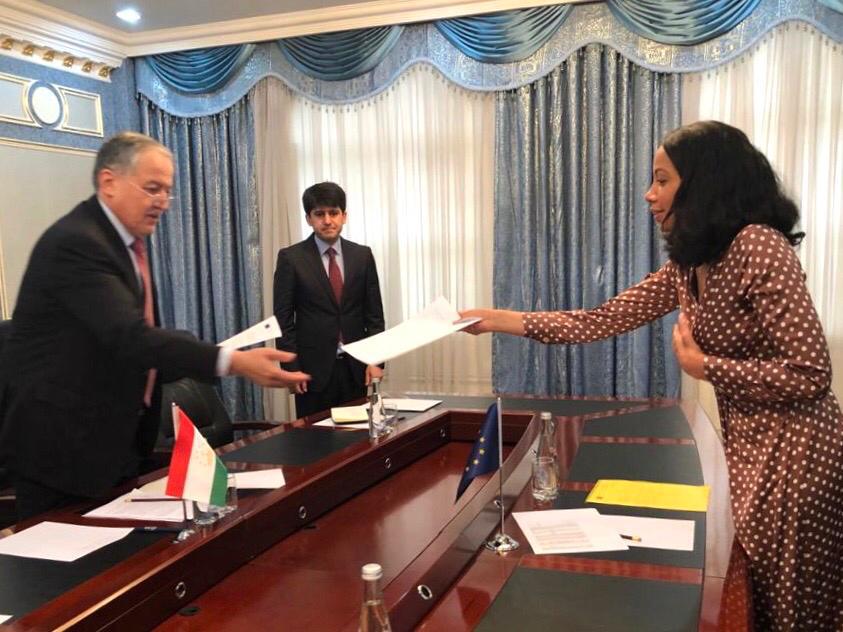
Ms. Marilyn Josefson, Ambassador, Head of EU Delegation to Tajikistan on April 13 and 14 held meetings with Tajik Foreign Minister Sirojiddin Muhriddin, Tajik Minister of Economic Development and Trade Zavqi Zavqioda and Tajik Deputy Finance Minister Yusuf Majidi.
Ambassador Josefson announced the mobilization of an additional EUR 48 million of EU funding to support Tajikistan in its comprehensive COVID-19 response. The areas of support include both an immediate emergency response as well as a top-up of funding in critical areas where the EU is already providing substantive support as part of its ongoing medium to long-term program, to mitigate the socio-economic impacts.
Besides, the International Monetary Fund (IMF) in May approved extending urgent loan to Tajikistan worth US$189.5 million to help meet the country’s balance of payments and fiscal financing needs, and the Eurasian Development Bank lent another US$50 million in November.
Other international financial institutions, including the World Bank and the Asian Development Bank, also provided grants to Tajikistan for COVID-19 response.
Recall, the Government of Tajikistan revised revenues and expenditures of the national budget for 2020 in June last year due to the novel coronavirus (COVID-19) pandemic.
Over the first ten months of last year, Tajikistan had spent on health care two times more than the last year’s revised budget projected for this sector.
The revised budget deficit was projected to stand at 3.1 billion somonis, which is 3.7 percent of the country’s gross domestic product (GDP), instead of the previously projected 350 million somonis (0.4 percent of GDP).
To cover such a huge deficit, the government had to use loans and grants received from the international financial institutions as well as part of the country’s gold reserves.