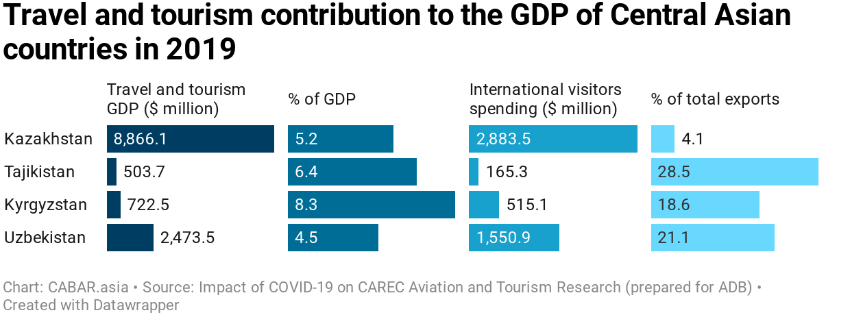
Central Asian countries are currently trying to recover their tourism economies. Just like in the rest of the world, this industry in the region was affected one of the first and more than others.
Kazakh journalist Laura Kopzhassarova notes that amid the coronavirus pandemic, the proposals about tourism cooperation between the countries of the region and the creation of a single tourism market appear.
In December 2019, the business community of Kazakhstan, Uzbekistan, Kyrgyzstan and Tajikistan signed in Almaty (Kazakhstan) an agreement on cooperation in the field of tourism and the creation of a regional tourism product at the Central Asian Regional Economic Cooperation (CAREC) tourism seminar. Within the framework of this agreement, these countries can initiate many tourist routes in Central Asia for visiting several countries at once.
During the same event, it was reportedly proposed to create a Tourism Council of the countries of the region for intercountry coordination and interaction in the tourism industry, following the example of the Asia-Pacific Tourism Association, and to start forming a single information network for tourism and government authorities.
However, despite these favorable conditions for the creation of a joint regional tourism product and the expansion of interaction and cooperation, there are a number of issues in the Central Asian tourism sector that need to be addressed at the interstate level.
They are: the necessity to simplify the rules of border, customs and migration control; the introduction of a unified Silkway Visa; the development of transport and information communications; the introduction of unified standards of tourist services; a single system of professional and advanced training of personnel; agreement on the methods for collecting and processing statistical data in the field of tourism.
In addition, it is necessary to address the creation and joint promotion of competitive tourism products of the Central Asian countries at the international level, and the creation of a single database on the tourism opportunities of the region.
Some tourism officials in Central Asia say it is necessary to adopt a joint program for the tourism restoration in the region.
Meanwhile, according to the international experts, despite the high tourism potential of the region, the world still knows very little about it. The co-founder of the IndyGuide travel resource, an ethnic Kazakh who grew up and lives in Switzerland Ati Tosun says that there is a lack of information about Central Asia and it is not available. He states that due to this and the low recognition level, the region often receives negative coverage.
During the Central Asian Trade Forum, various proposals were made on the title of a single tourist brand for the region. Some experts believe that the region can already be presented as the excellent post-COVID tourism destination.
Central Asia has a huge potential for the development of adventure tourism: there are a lot of natural monuments, various landscapes and a diverse climate.