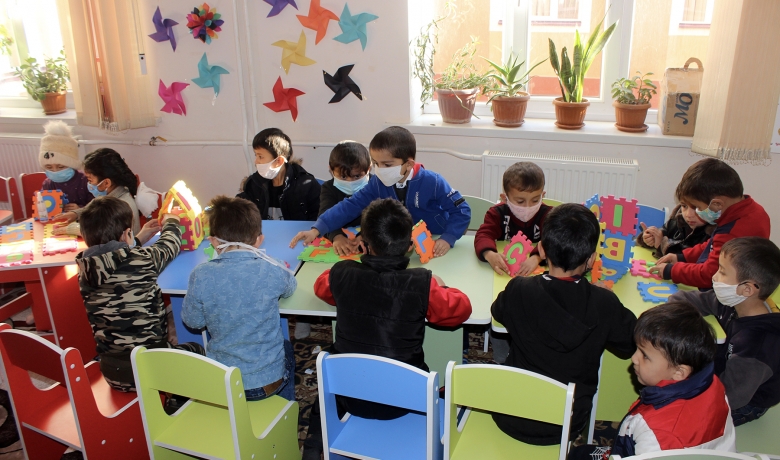
In an effort to increase the number of Early Childhood Development (ECD) centers and contribute to the implementation of national educational programs, OXFAM and the Aga Khan Foundation (AKF) established five ECD centers in Tajikistan.
According to the Aga Khan development Network (AKDN), AKF entered into a partnership with OXFAM Tajikistan to extend ECD centers into the Khatlon province and implemented the project entitled “Care Work and Empowerment: Creating the Conditions for Equal Opportunities in Rural Areas of Tajikistan”, Phase II.
The main objective of the project is to recognize, reduce and redistribute unpaid care-work in rural communities of Tajikistan. AKF’s contribution came through the establishment of five ECD centers in Khatlon region, which reduced the time women spent on childcare. The project implementation covers the period of March 1, 2020 to August 31, 2021, with a total budget 489,592 somonis.
Subsequent efforts to enable further replication are essential to adapt the model to new regional contexts and maintain a trajectory of growth in early learning and development for young children across Tajikistan.
“OXFAM, in partnership with the Aga Khan Foundation, has worked to establish an Early Childhood Development facility in our village,” said Sanavbar, whose daughter attends ECD in Dahana neighborhood. “I wanted my children to attend the ECD center as it is for pre-school ages. While my children will receive nurturing care in the ECD, I will feel secure about them and take more time to work or rest. My child will not stay wasting time but learn necessary skills before starting school, socializing with other kids and receiving quality education from trained teachers of the center.”
“Our ECD class is equipped with all needed equipment and learning resources. And, it is evident that children are very interested and excited to be in ECD,” said Gulbahor Abdurahmonova, an ECD teacher at Dahana School # 34. “I’m also very grateful to our trainers from the Institute for Professional Development (IPD) who teaches us what ECD is about by explaining the differences from general preschools. I can now say with confidence that it is different from getting ready children to school as our ECD helps children learn through play and develop their cognitive, social and emotional skills,” she added. “Many parents now request our school principal to find an opportunity and create an additional class, which demonstrates a growing demand for childcare services in our neighborhood. Our ECD gives children the best start in life by enabling them to achieve their full developmental potential in the future.”
Early childhood development (ECD) plays a pivotal role in the cognitive, social, emotional and physical development of young children. The early years of a child’s life provide the foundation for the development of life-long skills and all subsequent learning. Evidence from ECD programs world-wide has demonstrated conclusively that intervention in early childhood provides a unique opportunity to avoid future learning and other problems.
OXFAM carried Rapid Care Analyses in 2018 in Zarafshon and Khatlon regions among 22 communities to analyze implications of Unpaid Care for development assistance. The research findings showed that in Tajikistan unpaid care burden is high. Gender norms typically shifts higher burden of household chores on women: and poor quality of childcare is included. Recognizing that childcare is a responsibility of the larger community and setting up educational childcare centers will ensure holistic development of children, and also ensure a change of norms in valuing women and girls rights (to health, education, rest and leisure). OXFAM with cooperation of AKF initiated the project on creating 5 ECD in Khatlon province.
Since 2009, the Aga Khan Foundation (AKF), in collaboration with government and non-government partners, has contributed significantly to improving access to early learning and development opportunities for children aged three to six years in rural and remote communities by supporting the establishment of 311 ECD centers in Tajikistan. Evidence from ECD programs world-wide has demonstrated conclusively that intervention in early childhood provides a unique opportunity to avoid future learning and other problems.