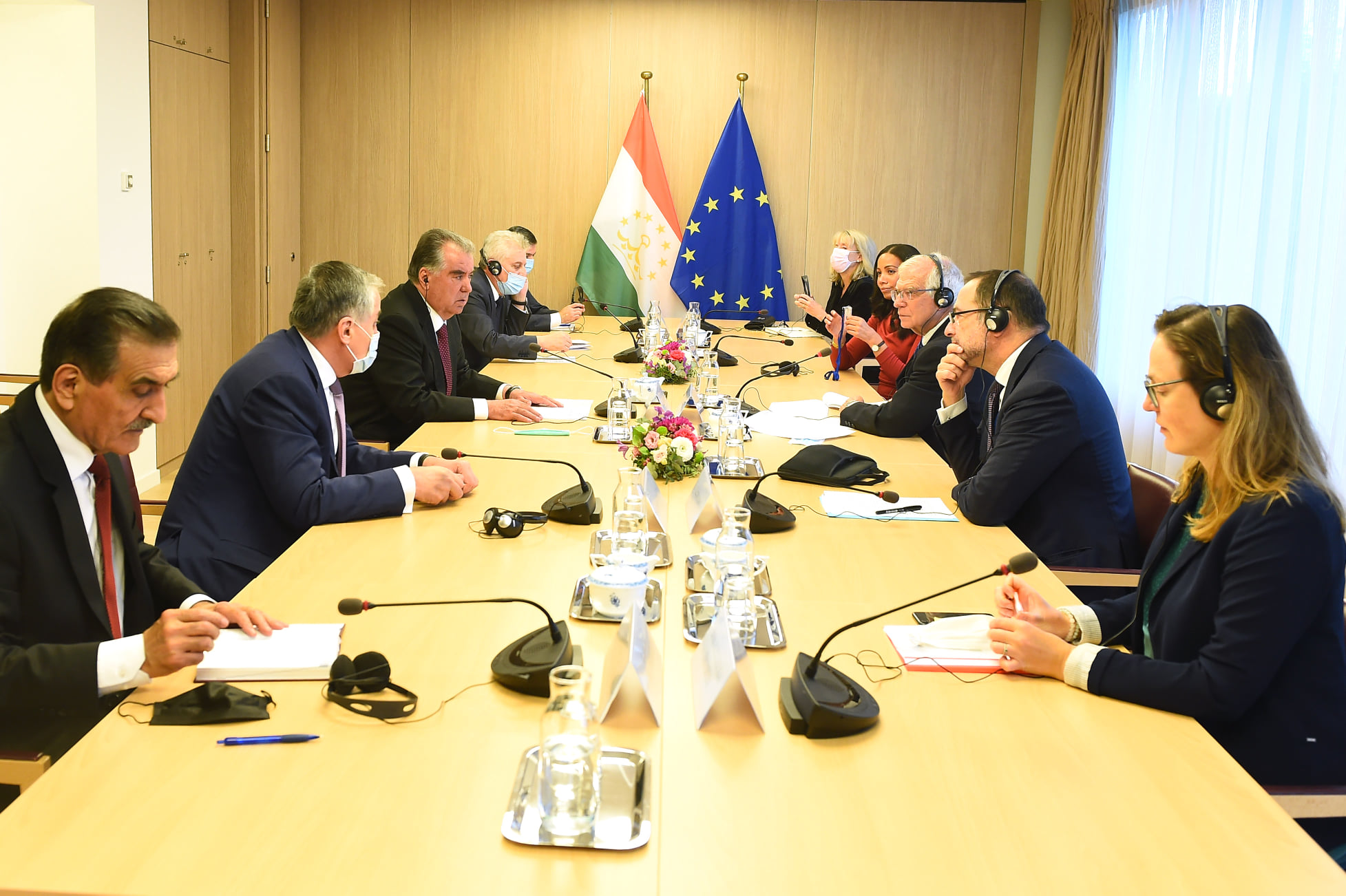
Tajik President Emomali Rahmon yesterday met in Brussels with Mr. Josep Borrell, EU High Representative for Foreign Affairs and Security Policy / Vice-President of the Commission (HR/VP), according to the Tajik president’s official website.
In the course of the talks, the parties reportedly discussed bilateral cooperation between Tajikistan and the European Union in promising sectors of the economy and the fields of cultural, education and health care.
Rahmon and Borrell also exchanged views on the issues related to cooperation on eradicating COVID-19, rational use of water resources, climate change and mitigation of its effects, protection of glaciers.
During discussion of the issues, Tajik leader appreciated the European Union’s support for elimination of economic and social consequences of the spread of COVID-19 and enhancement of the country’s health sector through providing more than 112 million euros, the Tajik president’s official website says.
It was noted that expansion of economic cooperation was one of the most important aspects of relations between Tajikistan and the European Union.
In this regard, the parties expressed satisfaction with the level and content of cooperation in the field of energy, including implementation of the CASA-1000 project and formation of the “green economy.”
Emomali Rahmon also expressed gratitude to the European Union and its member nations for supporting global initiatives of Tajikistan on water issues and mitigation of climate change effects.
For his part, Mr. Borrell reportedly noted that the European Union highly appreciated an important role of the Tajik side in solving water problems and mitigating climate change effects.
He also noted that the European Union was interested in expansion of regional cooperation and those issues would be in the focus of the upcoming meeting G5+1 ministerial meeting that would take place in Dushanbe.
In the course of the talks, the parties reportedly discussed issues related to strengthening security and stability in Tajikistan, throughout the Central Asian region and in Afghanistan.
At the end of the meeting, the parties expressed confidence that multifaceted cooperation between Tajikistan and the European Union countries would continue to consistently expand.
The European External Action Service (EEAS) is a European Union (EU) department that was established following the entry into force of the Treaty of Lisbon on December 1, 2009. It was formally launched on December 1, 2010 and serves as a foreign ministry and diplomatic corps for the EU, implementing the EU''s Common Foreign and Security Policy and other areas of the EU''s external representation. The EEAS is under the authority of the High Representative for Foreign Affairs and Security Policy (HR), a post also created by the Treaty of Lisbon, whom it assists. The EEAS manages the EU's diplomatic relations with other countries outside the bloc and conducts EU foreign and security policy.