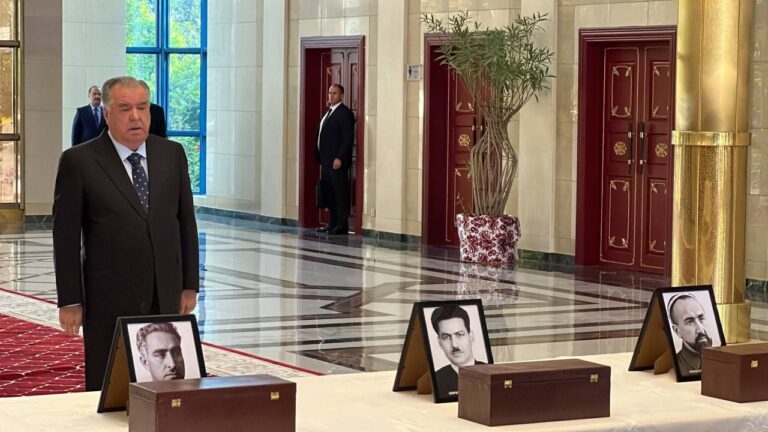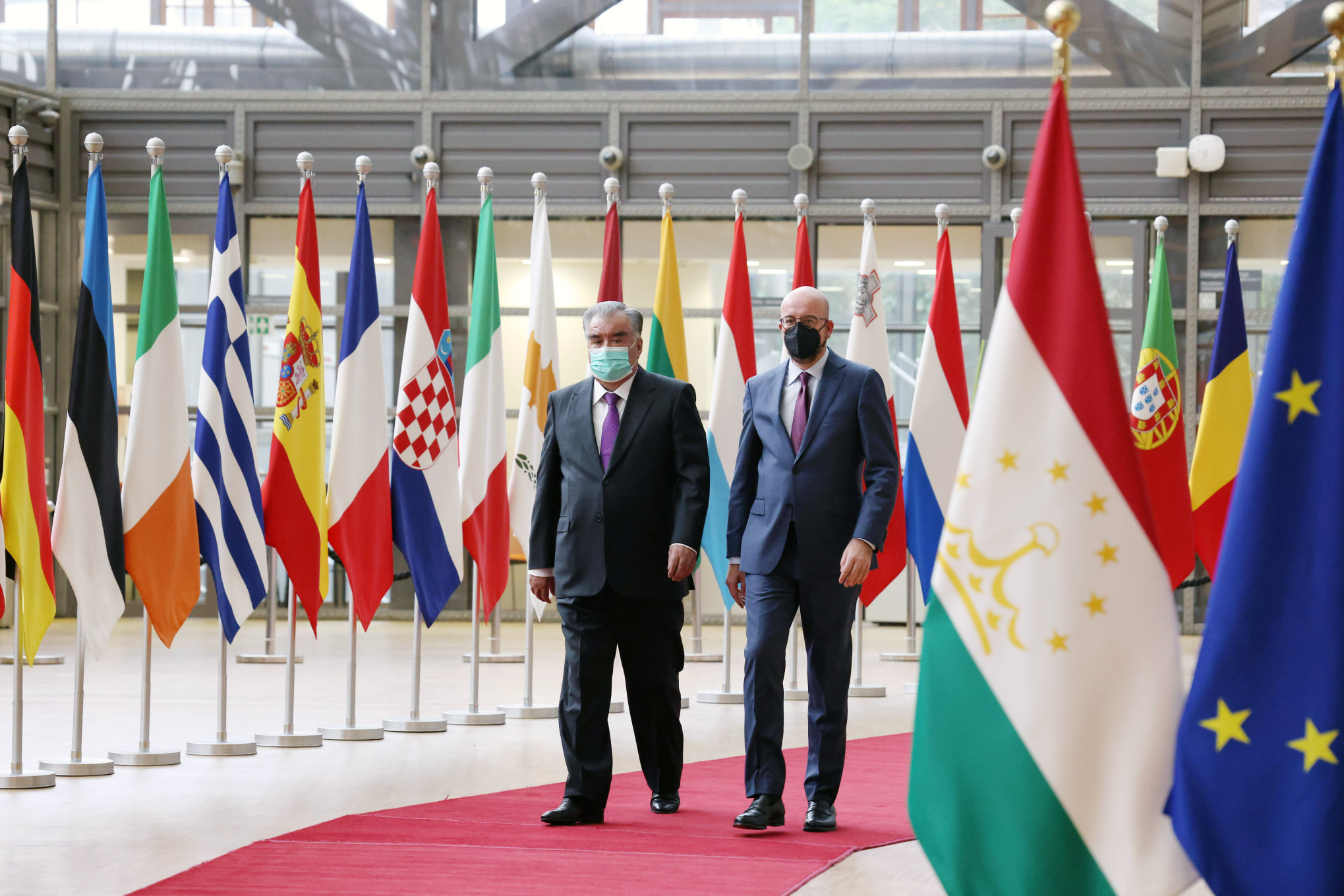
On Monday October 11, Tajik President Emomali Rahmon met in Brussels with European Council President Charles Michel.
According to the Tajik president’s official website, the parties discussed a wide range of issues related to bilateral cooperation between Tajikistan and Belgium.
Tajik leader outlined sectors like industry, mining hydropower, agriculture and tourism as areas, which could drive the bilateral trade between the two countries.
Rahmon and Michel reportedly noted the preparation and signing of an expanded agreement between the European Union and Tajikistan would benefit the parties.
They also pointed the significance of implementation of a new EU strategy for Central Asia ad a role of multi-year indicative program for 2021-2027.
The parties also discussed cooperation between Tajikistan and the European Union in sectors such as energy, water resources, climate change problems, and education.
A special attention was given to the current situation in the region amid latest developments in Afghanistan.
Emomali Rahmon invited Charles Michel to pay and official visit to Tajikistan, the Tajik president’s official website says.
The president of the European Council is the person presiding over and driving forward the work of the European Council, as well as a principal representative of the European Union (EU) on the world stage. This institution comprises the college of heads of state or government of EU member states as well as the president of the European Commission, and provides political direction to the European Union (EU).
From 1975 to 2009, the head of the European Council was an unofficial position (often referred to as the President-in-Office) held by the head of state or government of the member state holding the semiannually rotating presidency of the Council of the European Union at any given time. However, since the 2007 Treaty of Lisbon, article 15 of Treaty on European Union states that the European Council appoints a full-time president for a two-and-a-half-year term, with the possibility of renewal once. Appointments, as well as the removal of incumbents, require a double majority support in the European Council.
On November 19, 2009, the European Council agreed that its first president under the Lisbon Treaty would be Herman Van Rompuy (European People's Party). Van Rompuy took office when the Lisbon Treaty came into force on December 1, 2009 with a term stretching until May 31, 2012. His term was later extended with a second period ending on 30 November 2014.
The second and previous officeholder is former Polish Prime Minister Donald Tusk. He was originally elected to serve a term from December 1, 2014 to May 31, 2017 and subsequently re-elected on March 9, 2017 to a second term running from June 1, 2017 until November 30, 2019.
On July 2, 2019 the European Council elected Belgian Prime Minister Charles Michel as the successor to Donald Tusk as President of the European Council for the period from December 1, 2019 to May 31, 2022.