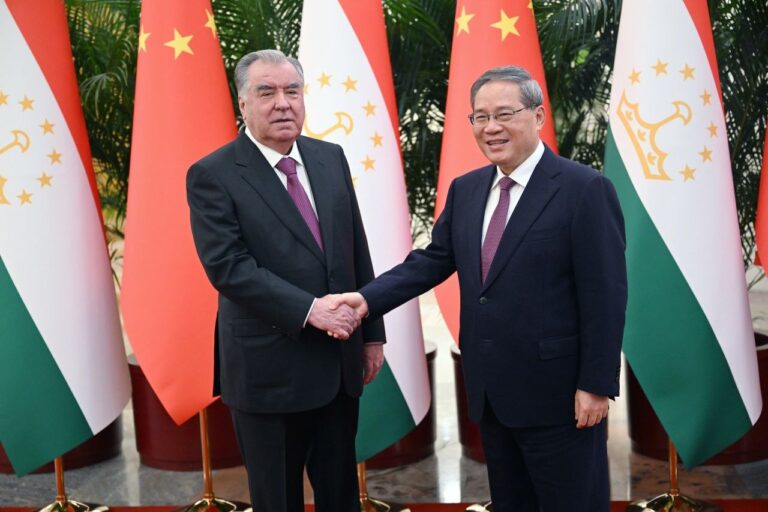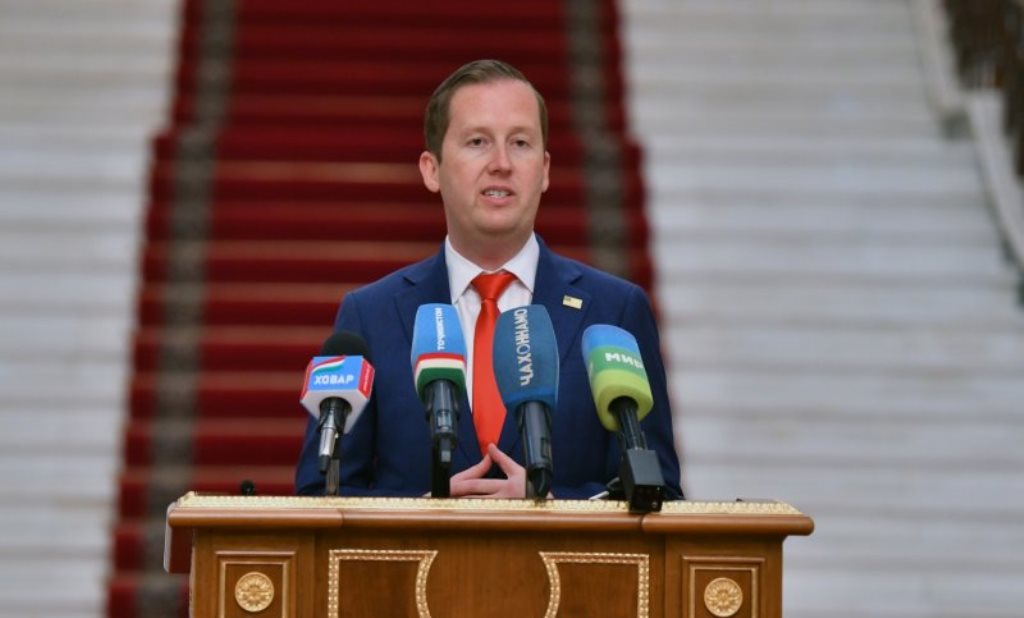
On April 28–29, Sergio Gor, the U.S. Special Envoy for South and Central Asia, visited Tajikistan for a two-day visit. During the visit, he held meetings with the Tajik high-ranking state officials, including President Emomali Rahmon, concluding a tour of Central Asia’s nations that began last fall.
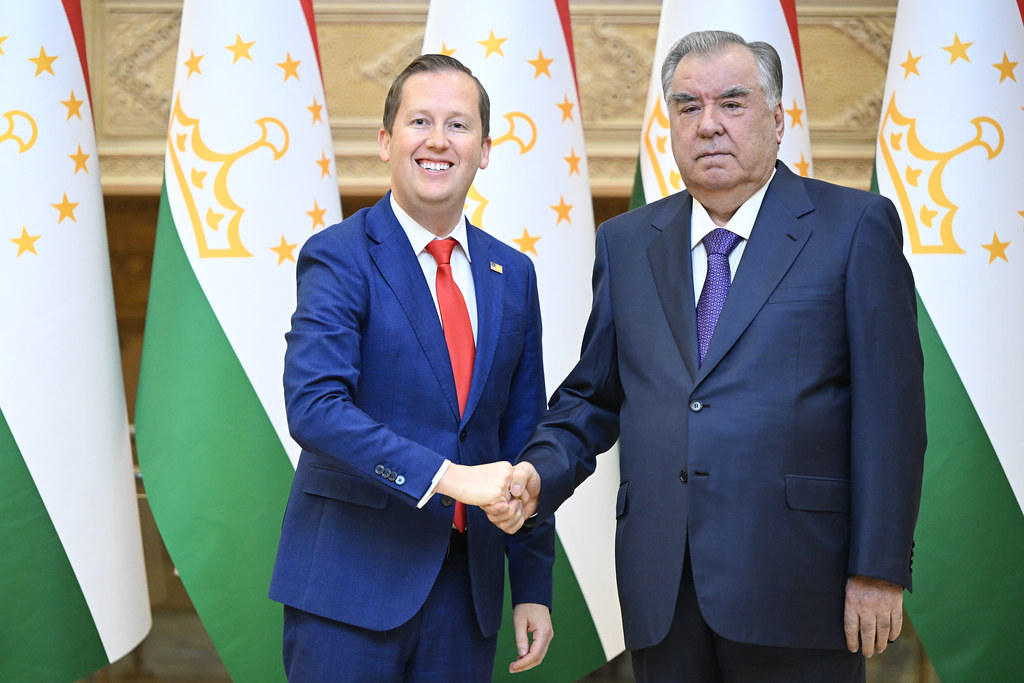
During the meeting with the head of state, special attention was reportedly given to the implementation of agreements reached at the “Central Asia – USA” Summit held in November of last year. Issues related to the current state and prospects of bilateral relations in the areas of economy, trade, investment, and security were also discussed.
Emomali Rahmon noted the need to utilize the potential of the Trade and Investment Framework Agreement (TIFA), as well as mutually beneficial cooperation in the fields of hydropower, mining and processing of minerals, light, food, chemical, and pharmaceutical industries, development of artificial intelligence, digital infrastructure, and digitalization of the economy, creation of joint enterprises for processing agricultural products for export, and attracting investments on this basis.
He reminded that the USA is among the top five leading investment partners of Tajikistan.
Below, we will attempt to analyze the significance of this visit in detail and determine the prospects for Tajik-American relations within its framework.
Central Asia at the center of Washington’s attention
The visit of the U.S. Special Envoy to Tajikistan should be considered in a broader context related to the current White House administration’s strategy in Central Asia.
This strategy pursues several goals: containing China and Russia in Eurasia, forming new supply chains in critical minerals and Eurasian transport and logistics routes, as well as seeking support for the American leader’s initiatives (like the Abraham Accords and the Peace Council) and investments aimed at strengthening U.S. citizens’ trust in President Trump.
But at the moment, perhaps the most priority task is containing China and its isolation, especially in the context of crises in the Middle East and the Afghan-Pakistani border, which isolate Beijing in global markets.
Central Asia will acquire critical significance for China in the event of prolonged tensions in these directions. Also important is the factor of China’s dominance in the global critical minerals market, which it uses as a leverage.
In such conditions, the USA seeks to reduce dependency on Beijing by forming alliances on rare earth minerals, attempting to integrate CA countries possessing significant potential of these resources. Recall that at the “Central Asia – USA” summit, the topic of critical minerals and deals in this area became key.
The aim of the visit
The visit of Sergio Gor to Central Asian countries may indicate that the USA is seriously considering strengthening its positions in the region. Washington intends to transfer the implementation of agreements reached during last year’s summit into a practical plane.
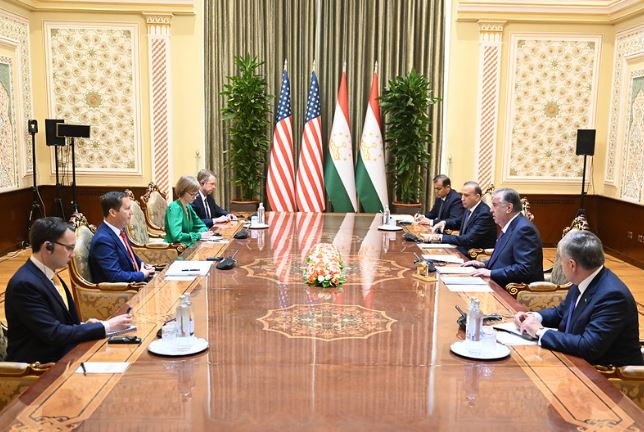
Despite the fact that the USA highlights Kazakhstan and Uzbekistan as the main partners in the region, a visit to countries like Tajikistan, considered the least attractive country, reflects the comprehensive-regional nature of the United States activity in CA.
A feature of the current U.S. strategy in Central Asia is attempts to expand trade and economic presence, and the mission of the American official is likely to study and prepare the necessary base for the entry of American business into the region.
As mentioned above, during Gor’s meeting with the President of Tajikistan, the priority areas of cooperation were precisely trade and economic directions.
It should also be recalled that in November of last year, multi-billion trade and investment agreements were signed between the USA and Tajikistan, which were emphasized during the special envoy’s meeting with the head of state.
What value can Tajikistan present to the USA?
In terms of the practical value of Tajikistan for American policy, first and foremost, there is the opportunity for comprehensive containment of China, which is pursuing an in-depth strategy in Central Asia covering all five countries and virtually all sectors of the economy.
Tajikistan possesses large reserves of natural resources. The country is rich in gold, silver, lead, zinc, copper, antimony, mercury, and other minerals. The value of minerals and metals (mainly gold, silver, zinc, antimony, and lead) at the “Uchkado” deposit alone could preliminarily be worth billions of dollars.
The Republic of Tajikistan is emerging as a leader in global critical resource markets. As per the U.S. Geological Survey, in 2023, Tajikistan ranked second in antimony production (21 thousand tons or about a quarter of global production). According to the country’s customs service, in 2023, Tajikistan exported antimony worth 107 million dollars, and in the first half of 2025, exports amounted to 286.5 million dollars.
Tajik antimony could acquire strategic importance for the USA in the context of attempts to introduce export control from China, which accounts for about half of the world’s antimony production. American investments in this sector could also serve as a deterrent to China, which has a significant presence in the extraction of this metal.
In this context, investment agreements such as those concluded last November between Tajikistan and the American company Transparent Earth, providing technical assistance and remote sensing capabilities for the mining and agricultural sectors worth 32.5 million dollars, acquire special value.
Challenges and opportunities for Tajik-U.S. relations
A number of opportunities are opening up for Tajik-U.S. relations today. First and foremost, as noted above, is the increasing attention of the USA to Central Asia, as well as specific and practical steps to expand its presence in the region, without excluding any country.
Another opportunity, however cynical it may sound, can also be considered the intensifying competition between the USA and China, especially in the sphere of critical minerals. In this context, the positions of the USA and Tajikistan, as shown in the above example, may converge.
Another positive aspect of the relationship may be the priorities of the current White House administration, which primarily focuses on trade and economic expansion of its presence in the region. Central Asian countries perceive this step very positively, which may increase their trust in Americans.
Despite the positive factors, Tajik-American relations may face challenges that could weaken the prospects for the development of bilateral relations.
The first challenge could be a possible change in American foreign policy with a change in the current U.S. administration. It should be noted here that American policy can be inconsistent in certain directions in the event of changes in White House administrations. Such peripheral regions for the USA as Central Asia could be particularly vulnerable to this prospect.
Another challenge could be the declarative nature, sluggish implementation, or even non-implementation of intended cooperation vectors. This is a fairly widespread practice in international relations, which is particularly notable for interactions between parties like the USA and RT.
Another challenge can be highlighted: the lack of sufficient knowledge and understanding of each other, the remoteness of political and economic cultures, and the absence of permanent high-level and expanded group contacts.
What can be proposed?
To further develop relations between the USA and Tajikistan, three generalized recommendations could be proposed (given the limited volume and nature of the material).