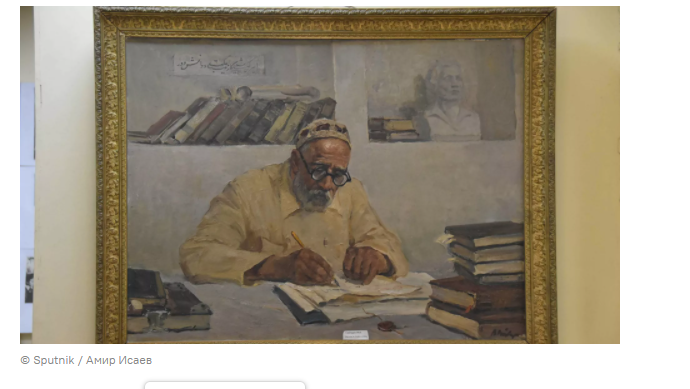
Representatives of Tajik intelligentsia and civil society ask the president and Dushanbe mayor to keep the House-Museum of Sadriddin Ayni in Dushanbe.
Appeals to Dushanbe Mayor Rustam Emomali, who is also Chairman of the Majlisi Milli (Tajikistan’s upper chamber of parliament) to keep the House-Museum of Sadriddin Ayni have been circulating in the Tajik segment of Facebook for many days.
Thus, Munavar Mamadnazarov, who has PhD degree in Architecture, explains why the house-museum of the great Tajik writer is much more than just a cultural monument or a point on the map of Dushanbe.
The idea of the Tajik authorities to demolish the House-Museum of the founder of the modern Tajik literature Sadriddin Ayni is puzzling.
The explanation is standard; they say “the building does not meet modern requirements.” With the same wording, a significant part of the architectural heritage, without which it is difficult to imagine a harmonious line of development in Dushanbe from a small village to metropolis, has already been demolished in the center of the city in recent year.
Now the turn of the “liquidators” has reached a small mansion, which has an official status of the national museum.
The very name “house-museum” unambiguously means that Ustod Sadriddin Ayni lived and worked within these walls.
And if instead of this elegant mansion, you will build even the Louvre or the Hermitage in some other territory, this building itself will never be directly associated with the memory of the person who glorified the Tajik language and literature.
It will be a fake that has nothing to do with real history and hardly be able to find a response in the hearts and souls of subsequent generations.
If we demolish the house of the writer in Dushanbe, admirers of his talent from Tajikistan will be forced to travel to Samarkand, where a humble house-museum of Ustod Ayni is located in the center of the old city, not far from Registan and the Gur-e Amir mausoleum. The construction of this house dates back partly to the beginning of the 19th century and the second part of this house had been built in the 1930s by Sadriddin Ayni and his friends.
Sadriddin Ayni (April 15, 1878 – July 15, 1954) was a Tajik intellectual who wrote poetry, fiction, journalism, history and lexicography. He is regarded as Tajikistan's national poet and one of the most important writers in the country's history.
Demolition of historical buildings in Dushanbe began several years ago as part of ambitious municipal redevelopment plan that includes the construction of modern building and the first was the building of the Main Post Office.
The authorities then demolished the Mayakovsky Russian Drama Theater and Jomi Movie Theater. Recall, the founding of the Tajik Soviet Socialist Republic was declared at the Mayakovsky Theater in 1929.
Plans to demolish some of the most popular landmarks in Dushanbe have sparked outrage and city residents have repeatedly signed petitions addressed to the president and Dushanbe mayor.