Tajik, Armenian leaders hold phone talks over situation along Armenian-Azerbaijani border

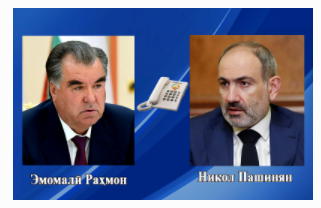
Tajik President Emomali Rahmon yesterday had a phone conversation with Armenian Prime Minister Nikol Pashinyan, according to the Tajik resident’s official website.  The conversation reportedly took place at the initiative of the Armenian side.   Armenian Prime Minister, who is rotating chairman of the Collective Security Treaty Organization (CSTO), informed Emomali Rahmon about the current situation […]

Tajik President Emomali Rahmon yesterday had a phone conversation with Armenian Prime Minister Nikol Pashinyan, according to the Tajik resident’s official website.  The conversation reportedly took place at the initiative of the Armenian side.  

Armenian Prime Minister, who is rotating chairman of the Collective Security Treaty Organization (CSTO), informed Emomali Rahmon about the current situation on the Armenian-Azerbaijani border. 

For his part, Tajik leader called on both parties to adhere to the agreements reached and resolve all disputes and conflicts only by political and diplomatic means.

According to media reports, tensions have again boiled over between Armenia and Azerbaijan, with multiple exchanges of fire in recent days.  The incidents come as the two sides are reportedly close to reaching long-awaited agreements to demarcate their border and to open new transportation routes between the two countries.

Armenian officials said that much of the fighting took place inside its territory, but did not specify a precise area.  Many Armenian media reported that it was near the lake Sev Lich in the Syunik region, where Azerbaijani soldiers crossed the border in May and have reportedly remained since then..

While Azerbaijan has claimed that this new round of fighting was set off by Armenian “provocations” along the border.  Azerbaijani analysts reportedly suggest that it was instigated by Baku in order to force Yerevan to sign new agreements, on border demarcation and new cross-border transportation routes, in support of last year’s ceasefire agreement.

Meanwhile Eurasianet says technically there is no border between the two countries in the absence of a bilateral agreement, and they are currently negotiating on a formal demarcation of their shared border.  But the two sides have reportedly already come to a de facto agreement based on Soviet maps, most visible on the road through southern Armenia that passes through some slices of Azerbaijani territory. 
Join us on social media!

Article translations:

Related Article

Оби зулол
Tenisi
Оби зулол

Most Read

Коммерсбонк Точикистон

Recent Articles

RZD announces the restoration of passenger services between Moscow and Dushanbe

Direct rail services between the capitals of Russia and Tajikistan were suspended in March 2020 due to the COVID-19 pandemic.

#AP30/Stories. “Selam! Heller nichek?” How Tatars live today in Sughd province

On the 30th anniversary of "Asia-Plus," we continue to publish reports that remain relevant even after years. This story was told in 2021, and since then, little has changed in the life of the Tatar community in Tajikistan.

15,000 cameras, drones, and robots: how technology monitors pilgrims in Mecca and Medina

During Hajj 2026, Mecca and Medina were under unprecedented digital control.

Another child in Dushanbe removed from family and sent to boarding school

The Ministry of Internal Affairs reports that the parents did not pay adequate attention to the child.

Emomali Rahmon instructs to address issues in seed production following criticism of the industry

Issues have been noted with certification, seed quality, and the material and technical base of the industry.

Water, climate, and a $130 billion deficit: seven key outcomes of the Water Conference in Dushanbe

At the forum, countries and international organizations discussed new mechanisms for cooperation, investments, and technologies that are essential for addressing the global water crisis.

Eskhata Bank introduces a new generation children’s wallet

"Eshkata Bank" has created a full-fledged digital platform that helps children aged 7 to 16 learn how to manage money.