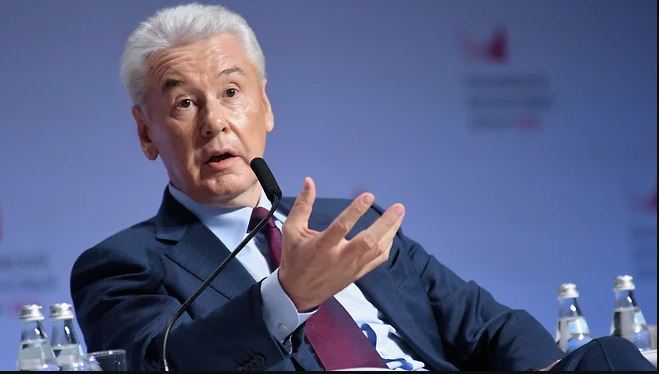
Vesti.ru reported on November 21 that Moscow Mayor Sergey Sobyanin has said in an exclusive interview with Russia 24 (a state-owned Russian-language news channel) that the Moscow authorities are working on a program for the gradual replacement of migrants by Russians at key projects in the capital.
“Because our Russian specialists, Muscovites, or people who come from other regions are people who constantly work in these industries. This is a different level of qualification,” the mayor explained.
He noted that since the beginning of the pandemic in the capital, there has been a decrease in the number of migrants arriving in the city.
“The number of migrants at construction sites in the city of Moscow, at least within the framework of our city order, has more than halved”, Sobyanin said.
At the same time, the mayor noted that an increase in construction volumes is being recorded in Moscow.
“The volume of … construction in Moscow has almost doubled compared to the level of 2016,” Sobyanin added.
Recall, Andrey Bochkaryov, vice-mayor of the capital for urban planning and construction, told RBC in an interview in late October that the Moscow authorities are preparing a plan to solve the problem of the personnel crisis at construction sites, which provides for the refusal of migrant labor. Due to the outflow of migrants into a pandemic, about 40% of workers are reportedly now missing at the capital’s construction sites.
According to Bochkaryov, construction should require three times less people and be carried out twice as fast due to high qualifications and new construction technologies.
Such work will be paid two to three times higher. According to him, such an experiment is already underway at a number of facilities. In addition, it is necessary to change the system of training construction engineers, the Moscow municipal official.
Meanwhile, citing Russian Deputy Prime Minister, Marat Husnulin, Interfax said on June 24 that about 5 million labor migrants need to be attracted to construction sites in Russia until 2024,
Now there is an acute shortage of labor resources both because of closure of borders due to the coronavirus pandemic and the demographic failure of the 1990s, Husnulin said, noting that labor shortages are the biggest constraints on development opportunities in Russia.
Regional administrators need to clearly understand how many jobs there are, how many Russian specialists can be found, and how much need to attract foreign workers, Russian official noted.
At least 5 million labor migrants are required until 2024, the vice-premier added.
It is to be noted that in the Russian Federation, most Tajik labor migrants work at construction sites. Labor migrants are still a critical component in Tajikistan’s economy and remittances sent by them to Tajikistan keep their families at home above the poverty line.