National power utility companies of Tajikistan and Afghanistan have reportedly signed an agreement on the supply of electricity from Tajikistan to Afghanistan in 2022.
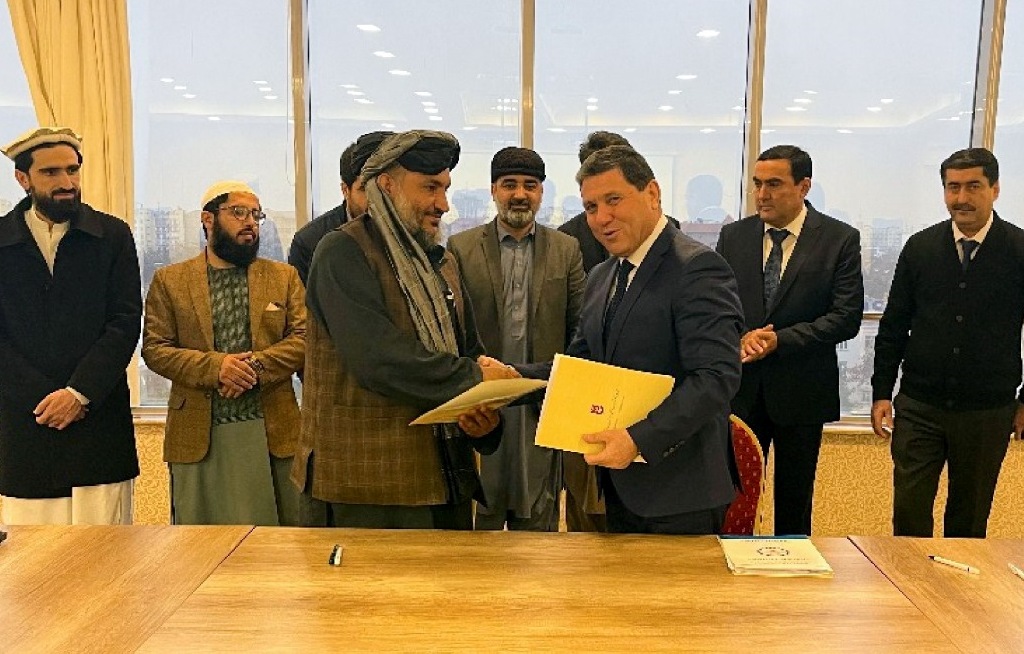
According to information posted on the official website of Barqi Tojik (Tajikistan’s national power utility company) the document was inked on December 26 in the Uzbek capital city of Tashkent by Barqi Tojik Director-General Mirzo Ismoilzoda and Da Afghanistan Breshna Sherkat (DABS – Afghanistan’s national power utility company) CEO Hafiz Mohammad Amin.
Under this agreement, Tajikistan will deliver daily up to 400 megawatt (MW) of electricity to Afghanistan from May to September next year.
Barqi Tojik emphasizes that the agreement is only of economic nature. .
Meanwhile, DABS’s website says the agreement was signed as a result of two days of negotiations between the two parties. The parties reportedly also discussed issues related to regional connectivity and development projects such as CASA 1000 and construction of 500 kV power transmission line.
DABS says that at the end of the visit, the Afghan delegation emphasized the importance of cooperation with Tajikistan and assured that the security and defense forces of the Islamic Emirate of Afghanistan (IEA) are ready to provide security for the suspended projects.
Recall, Tajikistan over the first eleven months of this year has exported about US$94 million worth of electricity, which, according to the Agency for Statistics under the President of Tajikistan, was 80 percent more than in the same period last year,.
Tajikistan now supplies electricity to Uzbekistan and northern provinces of Afghanistan within the framework of contracts concluded with power utility companies of these countries.
At the beginning of this year, the power companies of Tajikistan and Afghanistan signed an agreement on the supply of about 1.5 billion kWh of electricity from Tajikistan to Afghanistan in 2021.
Tajikistan supplies electricity to Afghanistan at the rate of 3.0 cents per 1 kWh through the 110 kV power transmission line and at the rate of 4.5 cents per 1 kWh through the 220 kV power transmission line.
In accordance with the reached agreements, Tajikistan reportedly supplies electricity to neighboring countries (Afghanistan and Uzbekistan) only during the May-September period.
Tajikistan has sufficient summer-time (defined as May 1 to September 30) hydropower surpluses to export to the neighboring countries.
In January-November this year, Tajikistan has reportedly generated 18.7 billion kWh of electricity, which is 5.7 percent more than in the same period last year.
However, electricity rationing is usually imposed in Tajikistan in the autumn and winter, especially after a dry summer. During these months, water levels are low and electricity consumption rises. Residents of rural areas experience extensive electricity shortages during the winter.
Barqi Tojik Company is fully owned by the Government. It owns and operates most of the electricity generating plants and is also responsible for electricity transmission, dispatch, and distribution services to around 8 million people in all regions of the country except for GBAO.
Two of the IPPs – Sangtuda-1 and Sangtuda-2 hydropower plants (HPPs) – were constructed with investments from Russian and Iranian state-owned companies, and supply electricity to Barqi Tojik under 20-year power purchase agreements (PPAs). Third IPP – Roghun HPP – is under construction.
Pamir Energy Company (PEC) generates and supplies electricity to more than 200,000 people in GBAO under 25-year concession agreement.
Two joint-stock companies — the Open Joint-Stock Company (OJSC) Power Distribution Network and OJSC Power Transmission Network — were established on the basis of Barqi Tojik in the summer of 2020 and heads of these two companies were appointed on November 11, 2020.
Recall, the process of restructuring of Barqi Tojik began in 2012 and Barqi Tojik was expected to be divided into three independent companies in late 2018: (i) generation; (ii) transmission business; and (iii) distribution. The main objective of the restructuring of Barqi Tojik is in ensuring transparency in the country’s energy system.
Da Afghanistan Breshna Sherkat (DABS) is an independent and autonomous company established under The Corporations and Limited Liabilities Law of the Islamic Republic of Afghanistan (IROA). DABS is a limited liability company with all its equity shares owned by the Government of Afghanistan (GoA). The company was incorporated on May 4, 2008 and replaces Da Afghanistan Breshna Moassassa (DABM) as the national power utility. DABS operates and manages electric power generation, import, transmission, and distribution throughout Afghanistan on a commercial basis.