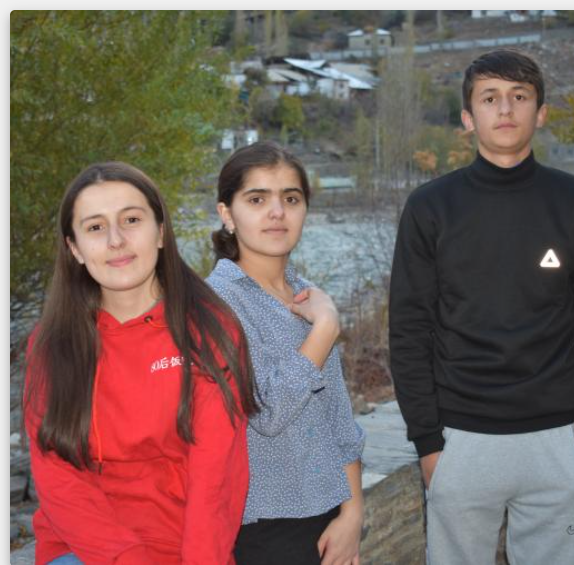
UNICEF Tajikistan Country Office notes that a 17-year-old Shahnoza from Khorog, the capital of the Gorno Badakhshan Autonomous Region (GBAO), had a genuine interest in environmental issues from an early age.
As a 7th grade student, she was reportedly inspired and determined to do whatever she could to protect the environment. Last year she took part in the UNICEF-funded Adolescents – Partners in Sustainable Development Project, in which she was able to unleash her potential.
During this project, young people and local authorities learned to interact and trust each other – importantly, this involves the participation of young people in decision-making processes. It was from this project that the full cooperation between young people and local authorities began. Young people have a lot of great ideas, but there is often no way to implement them. The project reportedly gives young people the opportunity to not only create their own project, but also to implement it together with the local authorities.
At the beginning of the project, the participants proposed a list of all existing problems in their region and divided them into several subgroups. Among all the topics voiced by Shahnoza, the most acute was the issue of safe sanitation and hygiene – an issue that worries many Tajiks, because according to the World Bank report, only 38% of the republic's population has access to clean drinking water.
Shahnoza and her friends decided to create a project that would improve the sanitary conditions in their city.
“We had a long discussion over who our target group would be, so we decided to conduct an analysis. Sulaimonsho, Dilangez and I visited the infectious diseases hospital. We spoke with the doctor and she gave us some shocking facts – in 2020 and in the first four months of 2021 – 894 people were hospitalized with a severe infection rate, most of them were children, especially those who go to kindergarten or primary school. …Therefore, we decided to opt for the children from kindergartens, partly because it is much easier for them to instill hygiene skills than it is for adults, who are already established in their ways,” explains Shahnoza.
During the event, the coaches taught Shahnoza and other teens to not only find problems, but also to analyze and solve them.
Thanks to UNICEF and the Program for Supporting the Development of Societies in Mountainous Regions (PPROGR), negotiations were organized between the young people and higher government agencies. These negotiations were not only successful, but also attracted a very important partner – the municipality.
During their project, the young people observed what difficulties kindergartens face. Some of them lacked basic sanitary and hygienic standards, such as clean toilets and safe drinking water.
As a result, the young people came to the conclusion that in order to meet the project budget and provide material assistance, it was necessary to prioritize the three institutions that needed support the most. The young people bought soap, towels and other hygiene products for the children and taught them how to use them correctly.
According to Shahnoza, waste management is another problem in the city. She says that it is not only children who litter, but also adults; if an adult sees a child litter the adult will not even comment to the child, as if it is a normal thing. Shahnoza says that maybe some people think that the streets should be dirty so that there is a desire to enter the house as soon as possible, but for most people the feeling of garbage in the streets is very uncomfortable.
All this made Shahnoza take environmental issues seriously and helped her choose the path of an ecologist.
She is currently studying at the University of Central Asia in the Earth and Environmental Sciences Department.