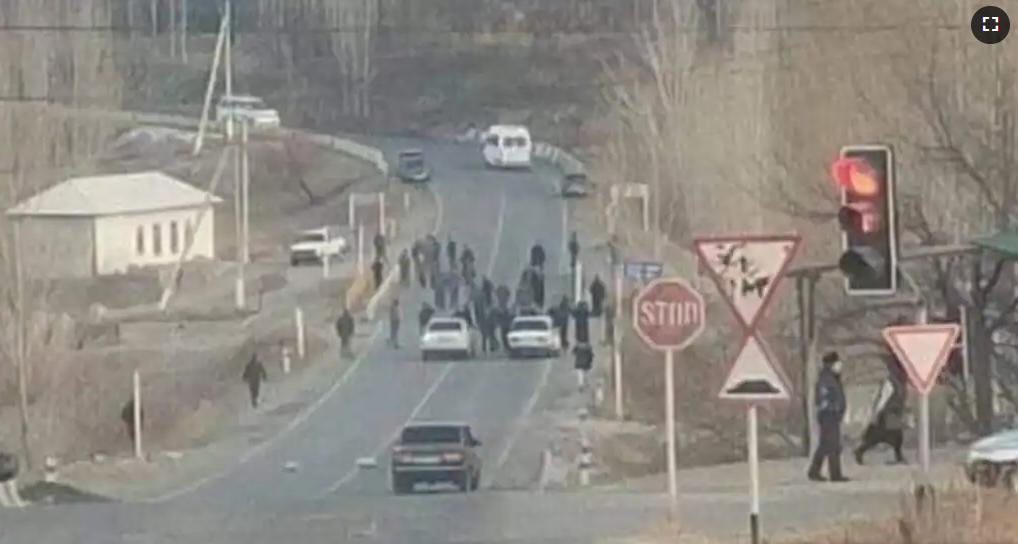
At least two persons killed and more than 30 others wounded in new fighting between Kyrgyz and Tajik border troops in a standoff over a blocked road. As usual, each side blames the other for starting the shooting.
Media reports say the clashes on January 27, the latest outbreak of violence between Tajikistan and Kyrgyzstan erupted along a segment of the countries’ poorly demarcated border.
Citing Tajik security officials, Radio Liberty’s Tajik Service reported yesterday night that at least one civilian was killed and 24 other people were wounded in the new clashes along the Tajik-Kyrgyz border.
Security officials in Tajikistan told RFE/RL’s Tajik Service yesterday that one Tajik civilian was killed and 17 border guards and civilians were wounded.
Meanwhile, the press center of Tajikistan’s Main Border Guard Directorate reported today morning that two Tajik nationals were killed and at least ten others, including 6 border guards and 4 civilians, were wounded in the fighting.
In the early hours of January 28, at 01:00 am, competent agencies of Tajikistan and Kyrgyzstan held talks in Tajikistan’s Surkh jamoat and reached a full cease-fire.
The Collective Security Treaty Organization (CSTO) that includes both Tajikistan and Kyrgyzstan said its secretary-general held talks with officials from both sides in an attempt to halt the fighting.
CSTO Secretary-General Stanislav Zas reportedly had telephone conversation with Tajikistan’s Security Council Secretary Nasrullo Mahmoudzoda and his Kyrgyz counterpart Marat Imankuov yesterday night and “called for an immediate ceasefire between the parties on the border of Kyrgyzstan and Tajikistan.”
Tajikistan’s border service says the current situation along the border is stable and a joint commission consisting of members of relevant agencies of both countries is currently studying the causes and factors of the border conflict.
Both countries accused each other of starting the clashes in the Tort-Kocho area in Kyrgyzstan’s western Batken region.
According to a statement released the State Committee for National Security of Tajikistan (SCNS), the Kyrgyz side fired at Tajik “residents, vehicles, and facilities.”
Kyrgyzstan’s security officials said the conflict started when Tajik citizens blocked a road crossing the disputed segment of the border. Kyrgyz border guards deployed along this segment of the border in Batken region were put on alert. Tajik military used mortars and grenade launchers.”
Recall, a similar clash that erupted along the disputed segment of the Tajik-Kyrgyz border in April last year left dozens of people dead on both sides.
Tajikistan and Kyrgyzstan have not yet resolved the border delineation problem. Many border areas in Central Asia have been disputed since the collapse of the Soviet Union in 1991. The situation is particularly complicated near the numerous exclaves in the Fergana Valley, where the borders of Tajikistan, Uzbekistan, and Kyrgyzstan meet.
The border of Kyrgyzstan and Tajikistan has been the scene of unrest repeatedly since the collapse of the former Soviet Union.
It has been difficult to demarcate the Kyrgyz-Tajik border because over the course of some 100 years Soviet mapmakers drew and redrew the Kyrgyz-Tajik border, incorporating land that had traditionally belonged to one people in the territory of the other Soviet republic.
Exclaves appeared and temporary land use agreements were signed.
All of this survived the collapse of the Soviet Union and people in Kyrgyzstan and Tajikistan have various Soviet-era maps they use to justify their claim to specific areas along the border.
Border talks between Tajikistan and Kyrgyzstan began in 2002. Only slightly more than half of the 970 kilometers of border shared by the two countries has been demarcated despite decades of attempts to bring the matter to a close. The border delineation problem has led to conflicts between rival ethnic communities.