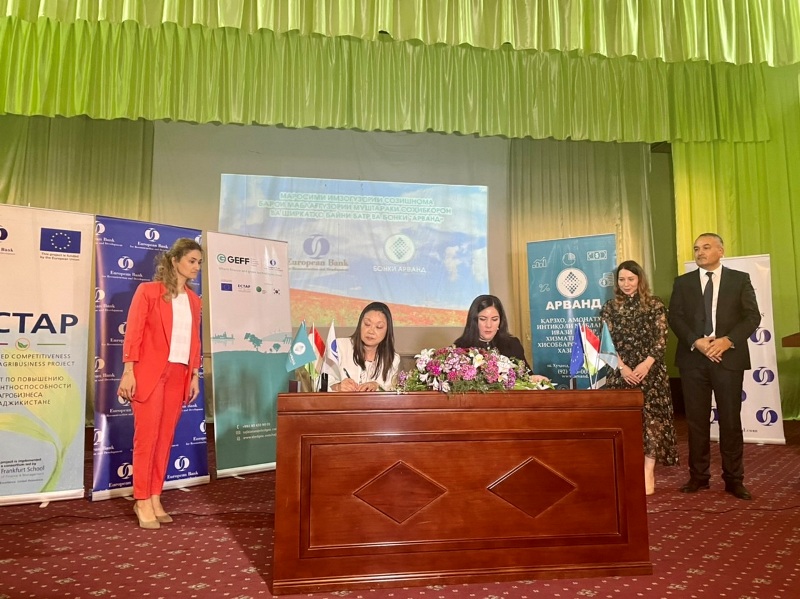
The European Bank for Reconstruction and Development (EBRD) is providing fresh funds and creating new growth opportunities for grassroot businesses in Tajikistan by offering a financial package of US$7 million to one of the country’s largest lenders Bank Arvand.
The official signing ceremonies held in Khorog, the capital of the Gorno Badakhshan Autonomous Region (GBAO), and in Danghara, Khatlon province.
The EBRD Resident Office in Dushanbe says the package reportedly consists of a US$3 million loan under the Bank’s Green Economy Financing Facility (GEFF), which will help increase access to green technologies for local households and small and medium-sized enterprises (SMEs) in the country. This loan is supported by concessional financing of US$0.75 million provided by the Green Climate Fund (GCF)
The GEFF, supported in Tajikistan by GCF and the Republic of Korea, will also use funds from the European Union’s Enhanced Competitiveness of Tajik Agribusiness Program (ECTAP), which promotes competitiveness in the agribusiness sector.
The US$1 million part of the package is provided under the EBRD’s Women of the Steppe Program supported by the Women Entrepreneurs Finance Initiative (We-Fi) and Switzerland through the Small Business Impact Fund (SBIF). This component of the package will help promote women’s entrepreneurship and business activity by assisting with access to finance, know-how and technical advice.
The two financial institutions are also signing a risk-sharing agreement of up to US$3 million under which the EBRD will share up to 50 percent of the risk on loans provided by Bank Arvand. This will allow the Tajikistan lender to provide much needed loans to SMEs in rural and remote parts of the country. Bank Arvand is the third financial institution in the country to sign such a facility with the EBRD.
The GEFF program is part of the Bank’s Green Economy Transition (GET) approach. It operates through a network of more than 145 local financial institutions across 27 countries, supported by more than €4.6 billion of EBRD finance for 190,000 clients to date. These projects have led to annual CO2 emission reductions of more than 8.6 million tons so far.
To date, the Bank has supported more than 90,000 women across 24 economies with financing and business advisory projects, training and mentoring as part of its Women in Business initiative.
To date, the EBRD has invested €854 million through 148 projects in Tajikistan’s economy.
Since its foundation in 2002 Arvand was a part of a regional project on microfinance in Ferghana Valley which was conducted by the representation of ACDI / VOCA in Tajikistan. Since that time MDO Arvand directs all its efforts to achieve understanding, meet the needs and expand mutually beneficial cooperation with the client. The organization provides loans with no pledge which allow low-income families and micro-entrepreneurs to increase their income and improve living standards. Other services offered by Arvand are opening deposit accounts, remittances, currency exchange and cash management services. Along with financial services Arvand also provides non-financial services: trainings and consultations.
Today Arvand has about 70 service points and employs about 900 qualified workers.