Kyrgyzstan relies mainly on services, remittances and natural resources. COVID-19 had a devastating impact on the country’s economy, with almost 40,000 of the 2.5 million workforce losing their jobs.
The Aga Khan Development Network (AKDN) says the pandemic exacerbated structural and gender inequalities in employment, with about 52 percent of low-income families reporting a deterioration in their financial situation.
In this context, the University of Central Asia (UCA) reportedly launched the Naryn Center for Entrepreneurship (NCE) in 2021. The Center aims to create job opportunities in mountain communities. It provides entrepreneurship and business incubation programs to teach students advanced business concepts, including leadership and management. It also provides them with a workspace, mentorship support and networking opportunities.
“The Center will help instil an entrepreneurial culture among the youth of Kyrgyzstan and hopes to extend [its] reach to the marginalized youth of rural communities. Instead of young people worrying about finding jobs, NCE will help them create jobs,” said Jomart Hudaibergenov, Manager of NCE.
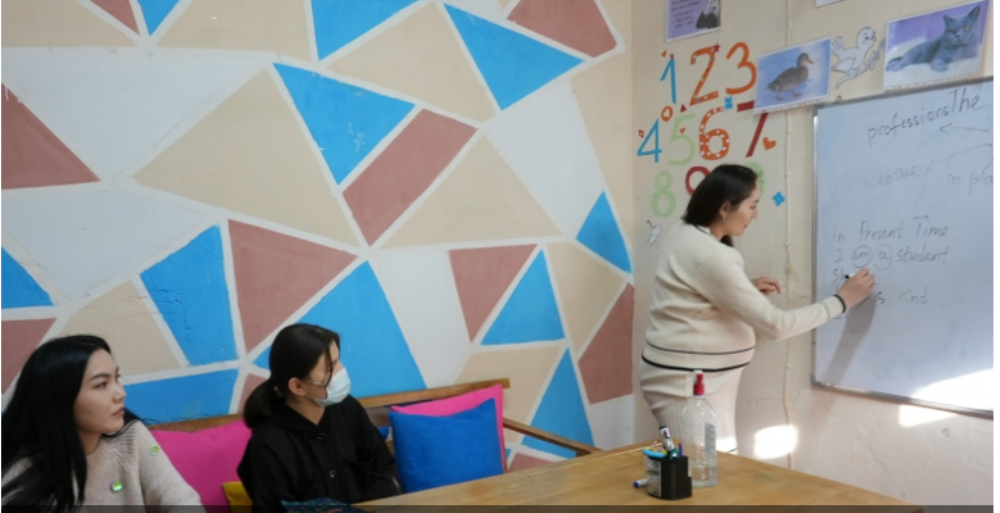
One of the first participants was Zhanara Erkinbek Kyzy. Hailing from Naryn city, Zhanara had graduated from Naryn State University in 2018 with a degree in English Language and Literature. But she struggled to find a job related to her field, eventually becoming a part-time tour guide at an art gallery.
With a family to feed, Zhanara did not give up on success. “If I could not find a livelihood then I had to build one for myself as giving up was not an option.” She took a loan of 20,000 KGS (US$ 240) to start an English Language Centre named Speak Up. She rented a room to establish her modest enterprise, and later hired two employees as business began to grow.
“I started earning decent money but felt I lacked the knowledge of important business concepts. In 2021, when NCE was launched and there was a call to join the first cohort, I grabbed the opportunity without hesitation. With UCA’s credibility and free-of-charge training, I finally had the chance to further develop my skills.”
Witnessing her professional growth, Zhanara’s husband enrolled himself in the second cohort at NCE. He is working on a business model for establishing a clothing boutique in Naryn. The couple also plans to further expand the English Language Centre: “NCE has provided us the knowledge to build our unique selling points so that our businesses stand out among the competition.”
“Never give up and always look for opportunities to make your dreams come true,” said Zhanara. “Life is too short to be afraid of embarking on new ventures.”
NCE was established with generous support from the United States Agency for International Development (USAID) and the Aga Khan Foundation (AKF). A similar center has been launched in Khorog, GBAO, Tajikistan.