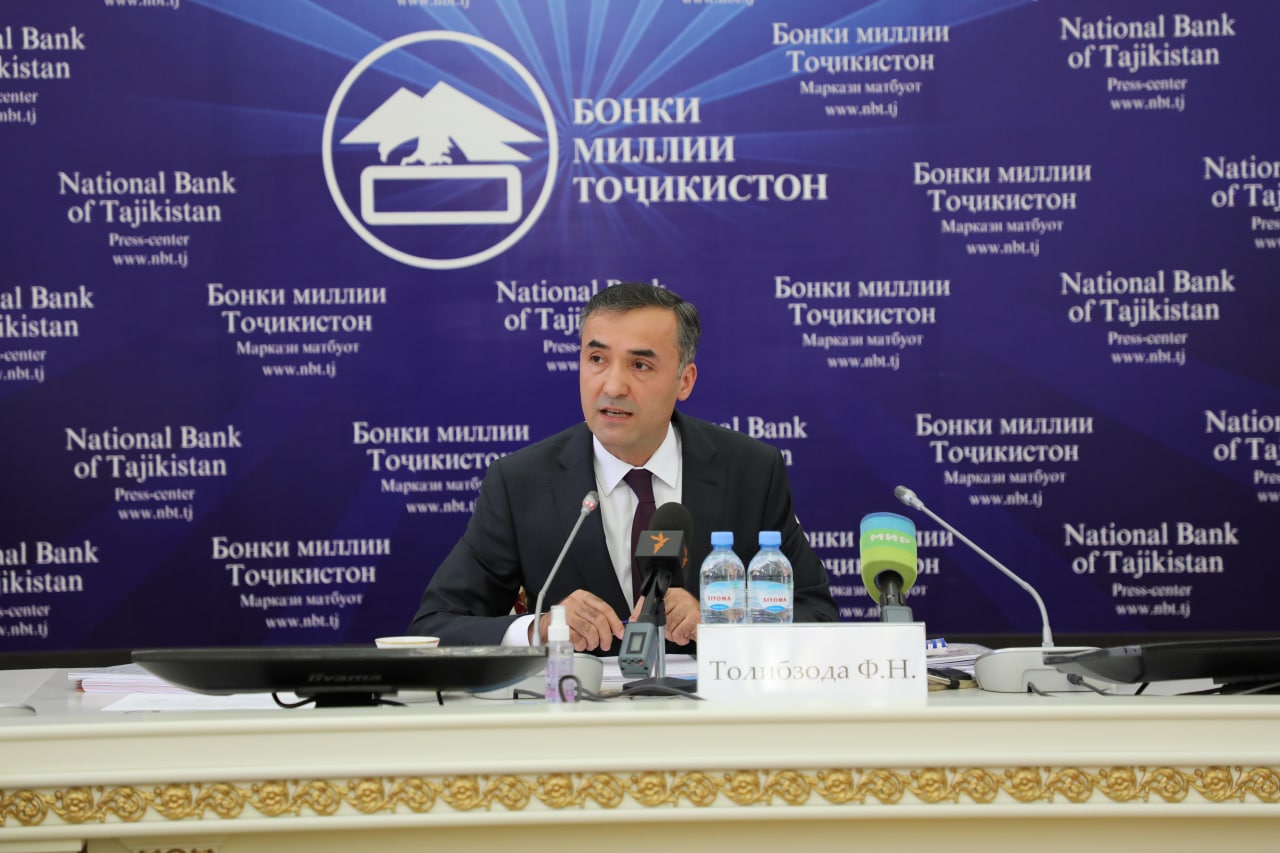
In a report released at a news conference in Dushanbe, the first deputy head of the National Bank of Tajikistan (NBT), Firdavs Tolibzoda noted on July 18 that the Tajik authorities has fulfilled all the conditions that have been put forward by the International Monetary Fund (IMF) for resumption of financial support within the framework of the Rapid Credit Facility (RCF) program.
According to him, this issue has been discussed repeatedly with representatives of the IMF. Tolibzoda expressed hope that the issue will be resolved in the near future.
The Rapid Credit Facility (RCF) provides rapid concessional financial assistance to low-income countries (LICs) facing an urgent balance of payments (BoP) need with no ex post conditionality where a full-fledged economic program is neither necessary nor feasible. The RCF was created under the Poverty Reduction and Growth Trust (PRGT) as part of a broader reform to make the Fund’s financial support more flexible and better tailored to the diverse needs of LICs, including in times of crisis. There are three windows under RCF: 1) a “regular window” for urgent BoP needs caused by wide range of sources including domestic instability, emergencies and fragility; 2) an “exogenous shock window” for urgent BoP needs caused by a sudden, exogenous shock; and 3) a “large natural disaster window” for urgent BoP needs arising from natural disasters where damage is assessed to be equivalent to or exceed 20 percent of the member’s GDP.
Access under the RCF is subject to annual and cumulative limits, with higher access limits applying for the large natural disaster window. For higher income countries that are non-PRGT eligible, a similar Rapid Financing Instrument (RFI) is available.
According to the NBT press center, the possibility of attraction of financial support for implementation of a new economic reforms program was discussed at a meeting of NBT Head Hokim Kholiqzoda and Tajik Finance Minister Faiziddin Qahhorzoda with IMF Managing Director Kristalina Georgieva that took place in the Swiss city of Bad Ragaz on July 3.
It is to be noted that the negotiations on granting a concessional loan to Tajikistan under the new IMF program have been going on for several years.
The previous three-year program, under which the IMF provided Tajikistan with a soft loan worth more than US$160 million, was completed in July 2012.
The negotiations of the official delegation of Tajikistan with the IMF on the development of a new program under the above mechanism began in October 2015.
The Extended Credit Facility (ECF) provides financial assistance to countries with protracted balance of payments problems. The ECF was created under the Poverty Reduction and Growth Trust (PRGT) as part of a broader reform to make the Fund’s financial support more flexible and better tailored to the diverse needs of low-income countries (LICs), including in times of crisis. The ECF is the Fund’s main tool for providing medium-term support to LICs.