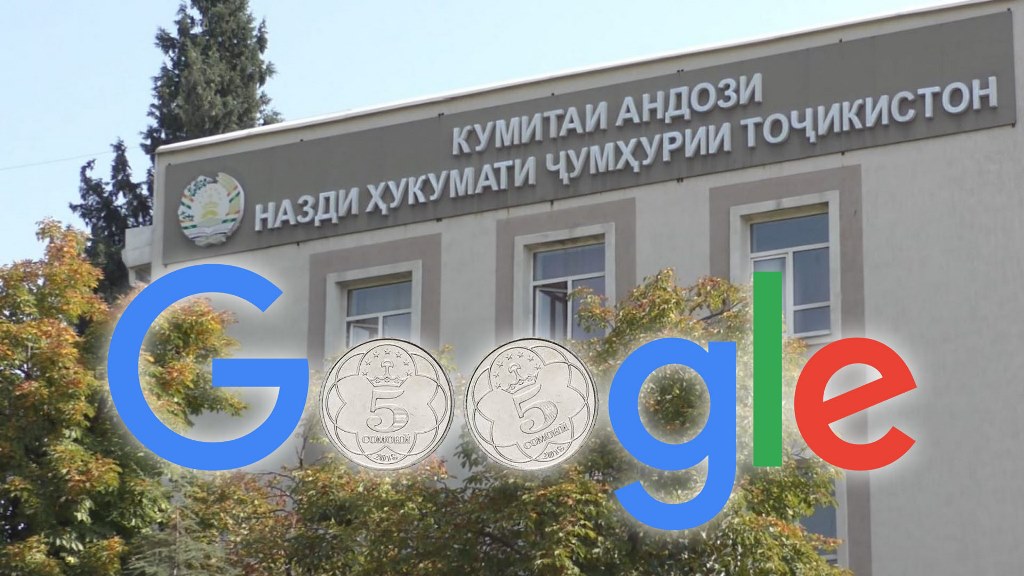
Tajikistan has already earned more than 3.5 million somonis (equivalent to about 300,000 U.S. dollars) through collection of ‘Goggle tax’.
'Google tax' is a popular term used to refer to anti-avoidance provisions that have been passed in several jurisdictions dealing with profits or royalties that have been diverted to other jurisdictions with lower or nil rates.
According to data from Tajikistan’s Tax Committee, Tajikistan received 2 million somonis last year and more than 1.5 million somonis over the first six months of this year through the collection of VAT from foreign companies engaged in providing internet-related services and products.
An official source within the Tax Committee says 23 foreign companies providing electronic services have been registered with the Tax Committee as of August 1, 2022.
Among them are Google Commerce Limited, Meta Platforms Ireland Limited, Apple Distribution International Limited, Netflix International B.V., Amazon Web Services EMEA SARL and others.
Recall, Tajikistan’s upper house (Majlisi Milli) of parliament seconded the law on amendments made to the country’s Tax Code on December 9, 2020 and the law was signed by the president on December 17, 2020. The law took effect on January 16, 2021.
The Tax Committee says the decision to tax online-giants was made following the rapid development of information technology and electronic commerce (e-commerce).
Tajik authorities reportedly studied the experience of Russia, Belarus, Uzbekistan and several European Union members while drawing up the changes to this law.
Tajikistan’s lower house (Majlisi Namoyandagon) of parliament adopted changes to the Tax Code that extend liability to international online transactions in November 2020.
Ads, products and services posted on sites of companies that will refuse to operate in accordance with Tajikistan’s tax legislation will be blocked.
Tajik authorities say the solution will not affect the price for Internet in the country.
The idea has been booted around for a few years now. In 2018, it was the Tax Committee that came forward with the idea of somehow forcing companies like Google, Facebook, Microsoft, Booking.com, Chinese online retail service AliExpress and others to pay tax inside Tajikistan. The Finance Ministry rejected the idea at the time. But the head of the Tax Committee, Nusratullo Davlatzoda, revived the proposal in February las year.
“Foreign companies are making a profit by providing services to our citizens. We must create an appropriate legal framework, so that [foreign companies] are able to register and pay taxes,” Davlatzoda told reporters in Dushanbe.
Social networking service Facebook Ireland Ltd was the first to file its papers with the Tax Committee under the Government of Tajikistan on March 2, 2021, being followed by American multinational technology company that specializes in Internet-related services and products Google, which bended to tax demands in Tajikistan on March 3, 2021.
They were registered as VAT payer through the Committee’s official website http://www.andoz.tj.
Foreign companies offering e-service now have to report quarterly and pay an 18 percent value added tax (VAT).
Meanwhile, Eurasianet says the 18 percent tax rate far exceeds what is levied by European countries that have implemented digital services taxes.