The Eurasian Development Bank (EDB) published its Macroeconomic Outlook for 2023 on November 29. The analysis reportedly summarizes economic developments in the Bank’s member nations in 2022 and provides key macroeconomic projections for the region’s countries for 2023 and 2024.
The report, in particular, notes that the region’s economies will continue adapting to the new environment.
EDB analysts have identified three main trends in the global economy. The first one is the record inflation not seen since the late 1970s. The second is a surge in central bank interest rates in both developed and developing countries. By November 2022, central bank interest rates in most developed countries had surpassed their 2010–2021 levels. The third is the weakening of global business activity. The world’s central banks are consciously sacrificing economic growth to prevent uncontrolled price increases in the future.
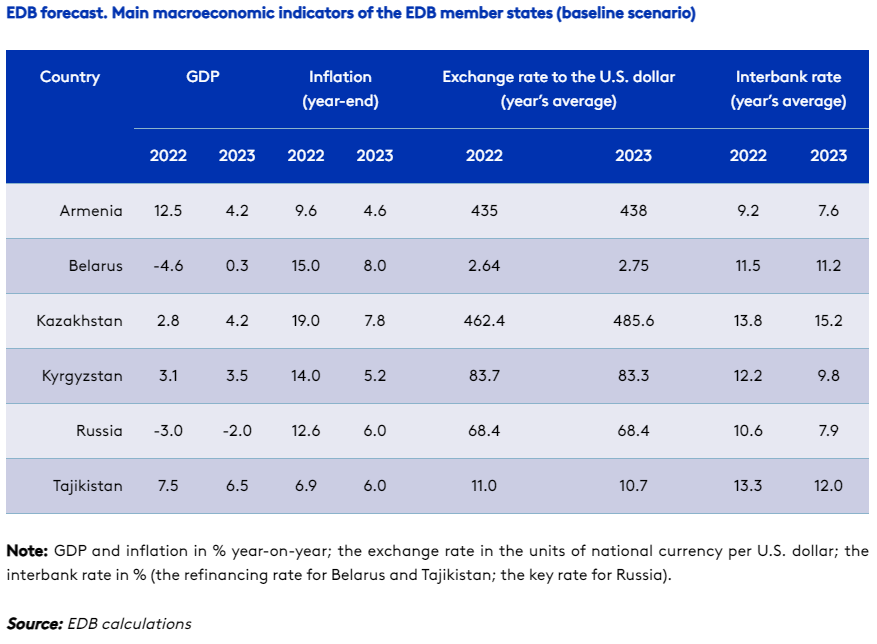
The report notes that economic developments in the EDB region have been mixed this year. As at the end of the year, the region-wide economic downturn could reach 2.3%, mainly due to expected GDP declines in Russia and Belarus by 3% and 4.6%, respectively. Meanwhile, the economies of Central Asia’s nations are expected to grow in 2022 thanks to increased domestic demand and high export prices. The EDB’s baseline scenario projects Tajikistan’s GDP to increase by 7.5 percent, Kazakhstan’s 2.8%, and Kyrgyzstan’s 3.1%.
The report says the Eurasian economies’ external environment could deteriorate next year. The Bank analysts note the high probability of a recession in the Eurozone and the United States. Tightening financial conditions are expected to cause a decline in developed countries’ GDP in 2023. Evgeny Vinokurov, Chief Economist at the EDB, says: “This could be moderate – our baseline scenario expects GDP to fall by 0.3% in the United States and 0.6% in the Eurozone. China is forecast to see growth below 4.0%. As the world’s three biggest economies slow down, global GDP growth will decline from 2.4% in 2022 to 1.5% in 2023.”
According to him, weaker economic activity will start to curb inflation next year. “We assume that signs of easing inflationary pressures will prompt developed countries’ central banks to end their monetary-policy-tightening cycle as early as the first half of 2023. We project the last Fed rate hike in December 2022 and the start of a rate cut cycle as early as Q2 2023. That said, we also assume that in the medium term the U.S. interest rate will be maintained around 3% and that the Fed will tolerate inflation above the current target of 2%.” Vinokurov added.
Bank analysts expect the region’s economies to continue adapting to the new environment. In terms of economic developments in 2023, Russia’s GDP is projected to decline by 2% while the other countries will see growth in their GDPs: Armenia by 4.2%; Belarus by 0.3%; Kazakhstan by 4.2%; Kyrgyzstan by 3.5%; and Tajikistan by 6.5%.
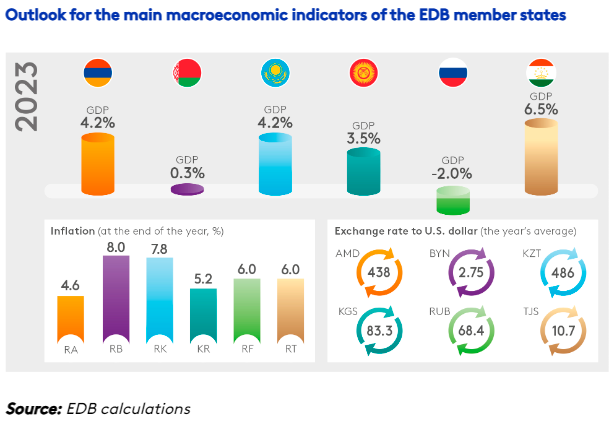
EDB analysts forecast that inflation in the Bank’s region will slow to 6.2% at the end of 2023 from 13.1% in 2022. However, inflation will continue remaining above central and national bank targets. A rather high inflation in the global economy will continue to have a pro-inflationary impact. The restructuring of production and logistics chains in Russia and Belarus will exert pressure on prices. Yet, the impact of these factors will gradually diminish, and price rises will slow down considerably. In 2023, inflation is projected at 4.6% in Armenia, 8.0% in Belarus, 7.8% in Kazakhstan, 5.2% in Kyrgyzstan, 6.0% in Russia, and 6.0% in Tajikistan.