Tajikistan has adopted the pasture development program designed for 2023-2027.
The state-run news agency Khovar says the program was adopted at a government session that was held by President Emomali Rahmon on November 29.
Speaking at the session, Rahmon emphasized the importance of development pastures as animal husbandry is an important industry for the development of the country.
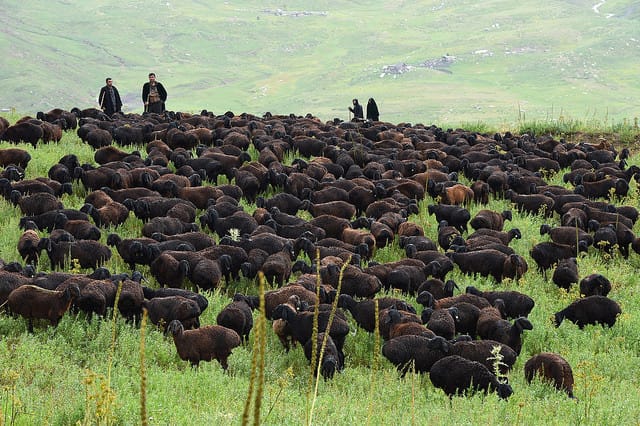
Head of the Pasture and Reclamation Trust at the Ministry of Agriculture, Safarali Nazarov told Khovar in an interview that Tajikistan’s roughly 3.8 million hectares of 4.7 million hectares of agricultural lands in Tajikistan are pastures.
According to him, animal husbandry ranks second in terms of production of agricultural products following crop production.
In mountain areas, animal husbandry is reportedly the main source of income of households.
Pastures feed the country’s meat-producing livestock. But these natural resources, particularly year-round pastures near villages, are being depleted and degraded. But these natural resources, particularly year-round pastures near villages, are being depleted and degraded.
“The main objective of the pasture development program is in increasing reserves of natural pastures using modern technologies and increasing their productivity,” Nazarov said, noting that increasing pasture productivity promotes further development of the animal husbandry and creates the basis for strengthening the country’s economy.
According to him, 3.245 million somonis will be allocated for implementation of this program. The funds will used to improve pastures, construct bridges for animals to cross as well as repair existing and construct new “facilities for decontamination of animals.”
Besides, 24,791,800 somonis are expected to be provided for the implementation of the program from the World Bank-sponsored Tajikistan Resilient Landscape Restoration Project.
Nazarov says all categories of farms in the country now have more than 2.5 million head of cattle and more than 5 million head of sheep and goats. According to him, the private sector accounts for 93 percent of cattle and 83 percent of sheep and goats.
Meanwhile, according to figures provided by the Agency for Statistics under the Government of Tajikistan, all categories of farms in the country now have 2.597 million head of cattle, 6.262 million head of sheep and goats, as well as 85,000 head of horses.