



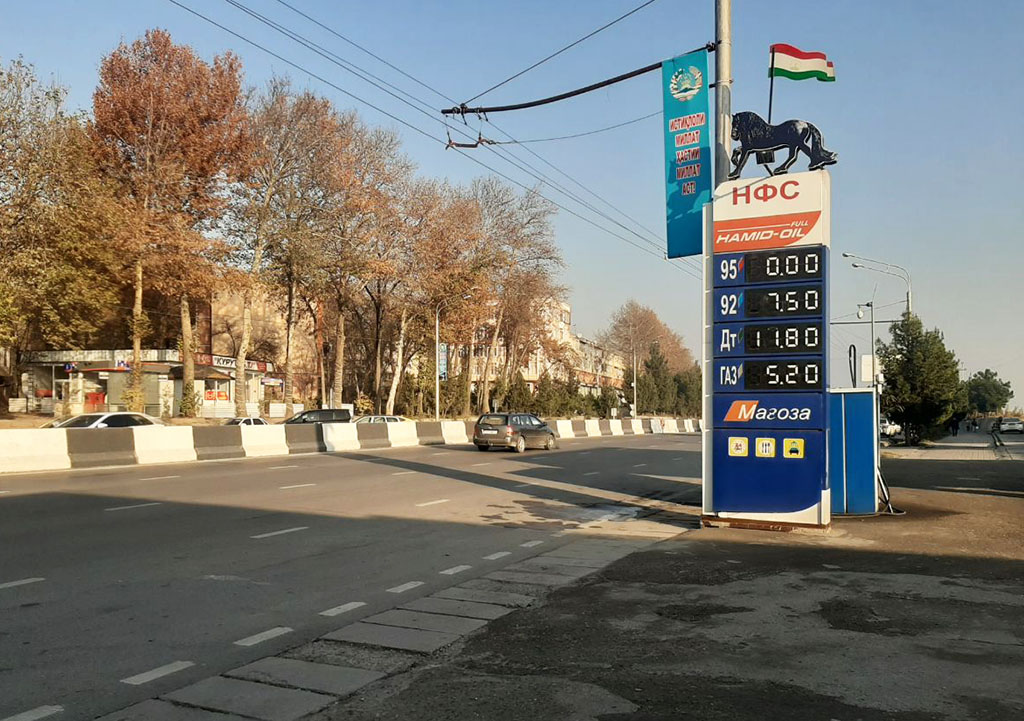
After November spikes, liquefied natural gas (LNG) prices have gradually decreased in Dushanbe from 6.20 somonis per liter to 5.20 somonis per liter (16-percent decrease). At some gas stations in the capital, you can buy it for 4.80 somonis per liter.
It is to be noted that according to official data, more than half of the country's motor vehicles use liquefied natural gas as fuel.
Prices for other fuels have also declined markedly in Dushanbe.
Thus, the price for one liter of 92-octane gasoline, which is the most sought-after grade of automobile gas in the country, fell in Dushanbe from 8.00 somonis in late November to 7.50 somonis on December 14.
The price for one liter of diesel fuel fell in the Tajik capital from 12.20 somonis in late November to 11.80 on December 14.
Suppliers say the price falls have resulted from the decreasing cost of petroleum products in the countries, which provide the bulk of Tajikistan's fuel imports.
According to data from the Agency for Statistics under the President of Tajikistan, Tajikistan has imported more than US$155.2 million worth of about 329,000 tons of LNG over the first ten months of this year, which is 11.1 percent fewer in volume terms and 11.3 percent fewer in monetary terms.
Meanwhile, an average import price for one ton of LNG has remained almost unchanged – US$487.00.
Kazakhstan provides the bulk of Tajikistan’s LNG imports, accounting for more than 86.2 percent of Tajikistan’s LNG imports.
Petroleum products imports over the same ten-month period have increased compared to the same period last year: by 30.1 percent in volume terms and by 80 percent in monetary terms.
Over the reporting period, Tajikistan has imported 645,000 tons of petroleum products.
Russia provides the bulk of Tajikistan’s petroleum products imports. Since 2013, more than 90 percent of all petroleum products have been imported into Tajikistan from Russia on concessional terms.
Recall, Tajikistan and Russia have reportedly made amendments to the indicative fuel balance for 2023. Following their meeting in Moscow, Tajik Deputy Energy and Water Resources Minister Sharif Khudobakhsh and Russian First Deputy Energy Minister Pavel Sorokin signed a document amending the indicative balance of petroleum product imports in late November. In accordance with this document, the overall volume of the indicative balance has increased, including the amount of deliveries of gasoline and diesel fuel to the internal market of Tajikistan as compared to last year.
Since the beginning of the year, retail prices for LNG and gasoline in Tajikistan have declined on average 15.1 percent and 10.9 percent, respectively, while retail prices for diesel fuel have risen on average 16.1 percent over the same period.






