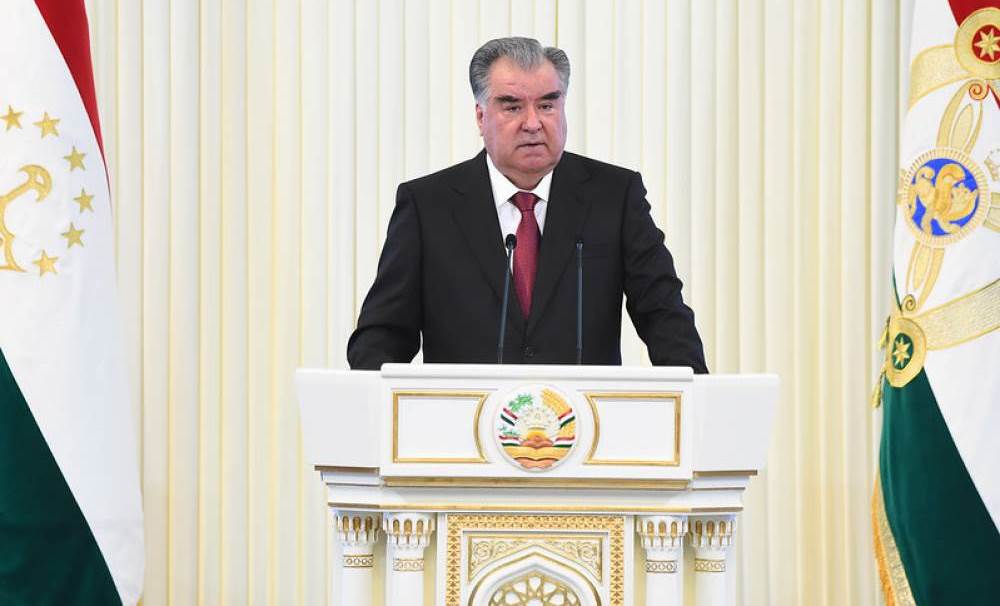
This year, Tajik President Emomali Rahmon is addressing a joint meeting of both chambers of parliament today.
Since 2015, the joint meeting of the Majlisi Namoyandagon (Tajikistan’s lower chamber of parliament) and the Majlisi Milli has taken place at the Kokhi Somon State Complex in Dushanbe.
Heads of all provinces, cities and districts as well as ministries and agencies have been invited to attend the meeting.
All Tajik national television and radio channels broadcast the president’s annual address. Students of higher educational institutions as well as senior students of high schools are gathered in their institutions’ auditoriums to watch Rahmon’s annual address.
In his address to the parliament, the president usually discusses the country’s priorities in domestic politics and foreign policy as well as the main economic challenges.
Today, Emomali Rahmon, in particular, noted in his address that over past five years, wages have increased 1.5 times and pensions 1.3 times.
Over the same five-year period, the poverty level in the country has reportedly decreased from 27.4 percent to 22.5 percent.
Rahmon noted that Tajik entrepreneurs have spent 12 billion somonis to finance construction of more than 8,000 facilities in the country over the reporting period.
“Over the first eleven months of this year, inflation in Tajikistan has stood at 4.2 percent, which is one of the best indicators within the CIS area,” the president noted.
He further noted that the number of industrial enterprises in the country has increased from 359 with 33,000 jobs in 1991 to 2,500 with 85,000 jobs this year.
“This year, 3.2 billion somonis (equivalent to 315 million U.S. dollars) has been spent for completion of the construction of the Roghun hydropower plant,” Rahmon said
“Under conditions of sanctions, when countries isolate, not allow exporting goods, we must give freedom to entrepreneurship and help entrepreneurs,” said the president. “In particular, we must improve the licensing system and reduce the number of permits for doing business by 60 percent.”
He also pointed to the necessity of gradually constructing four enterprises for processing gems and precious metals, especially for processing antimony, in Dushanbe beginning on 2023.