The World Bank’s Board of Executive Directors on January 12 approved US$15 million in grant financing from the International Development Association (IDA) for the Technical Assistance for Financing Framework for Roghun Hydropower Project (HPP) in Tajikistan (TA).
Press release issued by the World Bank notes that this TA aims to support the Government of Tajikistan in improving the financial and commercial frameworks of the Roghun hydropower plant and enhancing its technical, environmental and social sustainability.
The Roghun Hydropower Project reportedly has the potential to generate significant economic, social, and environmental benefits for Tajikistan and other countries in the Central Asia region if it develops in a financially, environmentally, and socially sustainable manner. Once completed, the Project will be critical in helping Tajikistan to meet its domestic energy demands, especially during wintertime, and to support neighboring countries through the export of surplus electricity. In addition, as a reliable source of clean and affordable electricity, the Roghun Hydropower Project can contribute to decarbonization of the Central Asia region.
The IDA grant will finance the hiring of experts on dam safety and environmental and social (E&S) frameworks to help with necessary improvements that will bring the project in line with current hydropower industry requirements and align with the World Bank’s Environmental and Social Framework. The TA project will also be instrumental in increasing the Project benefits to a larger number of people through a benefit-sharing mechanism whereby a portion of the project’s revenues would be channeled to various socio-economic programs and initiatives.
“Our technical support aims to improve the Roghun project’s development impact through greater sharing of the project’s revenues to benefit the people of Tajikistan, improvement of the project’s environmental and social performance, and expansion of clean electricity,” said Tatiana Proskuryakova, World Bank Country Director for Central Asia. “This support builds on our current investments in Tajikistan’s energy sector, which focus on improving electricity supply reliability for people and the economy, strengthening the governance of the sector, promoting financial sustainability, and increasing its transparency.”
The TA project would also improve the readiness of the Roghun HPP Project to increase the financing required for its completion. In particular, it would help to update the financing plan to ensure that annual spending on the project does not create macro-fiscal risks for the country and that the HPP has a reliable commercial framework for sale of electricity to domestic consumers and for exports.
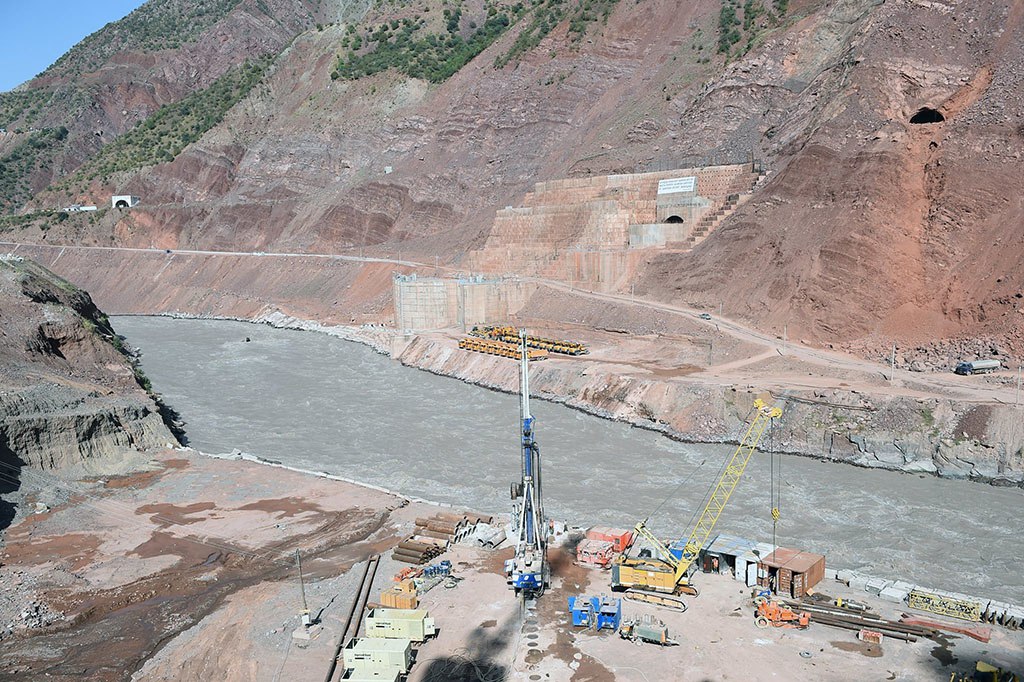
Recall, to complete the construction of the Roghun hydropower plant, Tajikistan founded OJSC NBO Roghun in April 2008 after it formally revoked a contract with Russia's RusAl aluminum company in August 2007. To raise funds to complete construction of the Roghun HPP the government started to sell shares in Roghun to people on January 6, 2010. Tajikistan has reportedly issued 6 billion somonis worth of 5 million Roghun shares.
In 2016, construction duties on Roghun were assigned to Italian company Salini Impregilo (currently Webuild).
The project is broken down into four components, with the most expensive one involving the building of a 335-meter-high clay core rockfill dam — the tallest in the world — which will entail costs of around $1.95 billion. Construction of the Roghun hydropower plant is expected to be completed in 2033.
Two of the six turbines have already started producing energy for sale to raise funding to complete it. The first turbine went into service in November 2018 and the second one was introduced into operation in September 2019.
The Ministry of Finance noted in early August last year that 37.7 billion somonis have been spent for construction of this hydropower plant since 2008.
If built as planned, the Roghun hydropower plant is expected to end chronic power shortages in Tajikistan and allow it to export electricity to neighboring countries.
In his address to a joint meeting of parliament, President Emomali Rahmon said on December 23 last year that the construction activities at the site for construction of the Roghun hydropower plant are ongoing dynamically. To this end TJS3.2 billion (equivalent to 315 million U.S. dollars) were channeled in 2022.