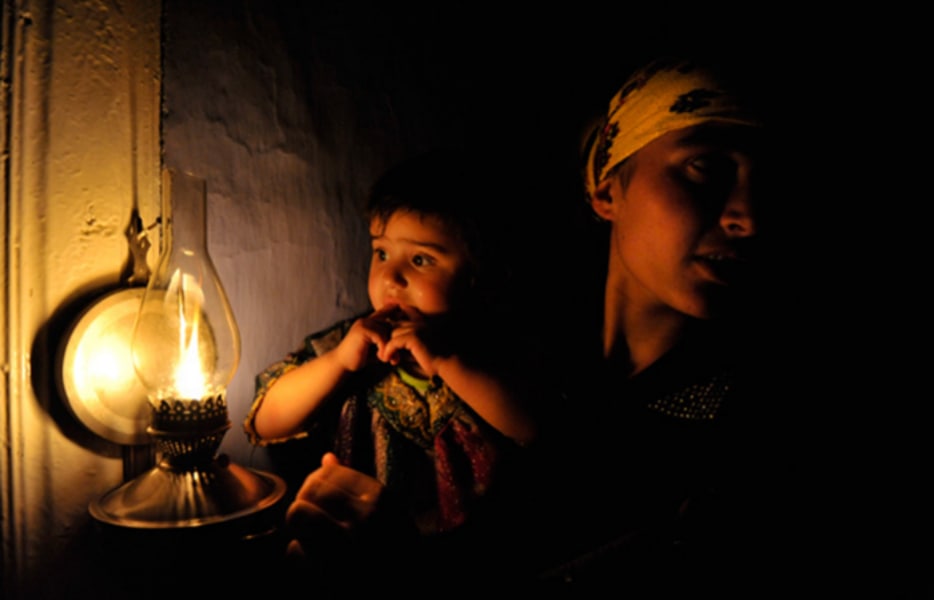
Residential customers in rural areas complain that contrary to president’s decree electricity supplies are restricted again.
Recall, Tajikistan’s power utility company Barqi Tojik has said households in rural areas will receive uninterrupted supplies of electricity starting from January 11. At the same time, Barqi Tojik pleaded with the public to avoid excessive use so as not to strain the grid.
A state television report attributed the end of the power rationing to President Emomali Rahmon’s concern over the particularly chilly weather gripping the country.
Under a power rationing that came into force in October, residential customers in rural areas were starved of electricity between 10:00 pm and 5:00 am daily.
Residential customers in some rural areas say they received uninterrupted power supplies only on January 11and electricity outages began just the next day.
They reportedly now do not have electricity between 11:00 pm and 5:00 am daily.
Meanwhile, relevant agencies note in response to widespread public complaints that repair works might have caused interruptions in the electricity power transmission in some areas.
Thus, Rajabali Boyakov, an engineer-in-chief at the power grids in Khatlon’s Kushoniyon district , told Asia-Plus that demand for electricity in their service area has increased this month.
“Compared to last year, the daily demand for electricity has increased from 2.5 million kWh to 9.6 million kWh. In Bokhtar city alone, the daily demand for electricity has increased by more than 600,000 kWh – from between 700,000 to 1 million kWh in January last year to 1.6 million kWh,” Boyakov said.
According to him, almost all power transmission lines in their service area have been serving for more than 50-60 years, and therefore, are already outdated and “they do not withstand this kind of loads.”
Tajikistan struggles with electricity rationing 30 years after independence, despite long-held dreams of becoming an energy export powerhouse.
Measures rationing electricity supplies are usually introduced in all regions of the country except Dushanbe, the Gorno Badakhshan Autonomous Region (in GBAO, the power grid is operated by Pamir Energy Company) and regional administrative centers and they seek to curb the country's rising electricity consumption.
The rationing results in the supply of daily electrical power being reduced to 12 or 10 hours. In addition to curbing rising consumption, the move also stems from a decline in the water level in the reservoir powering the country’s largest hydroelectric power station (HPS) Nurek.