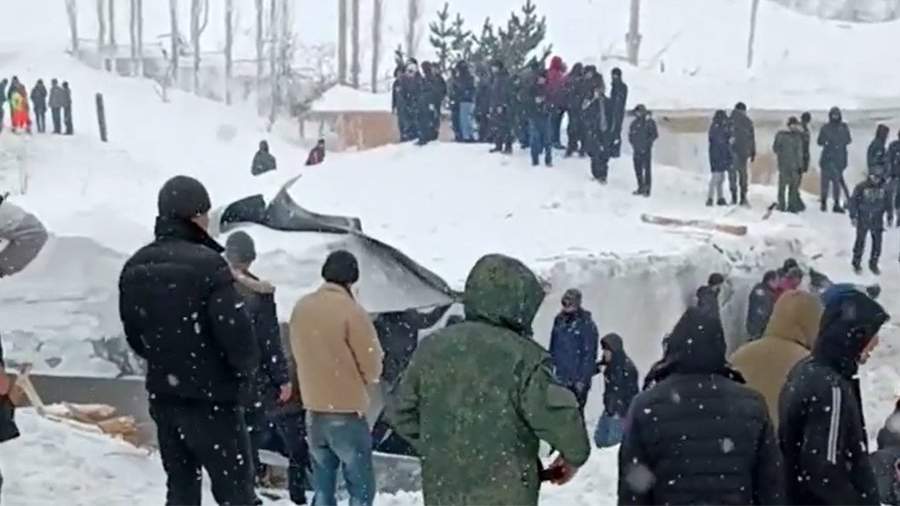
Avalanches in the Gorno-Badakhshan Autonomous Region, or GBAO, claimed at least 18 lives as of the morning of February 18. The dead reportedly are known to include two children, three schoolchildren and nine students.
Recall, an avalanche in Khorog’s Nosir-Khusrav neighborhood claimed at least 13 lives on February 15. At least 36 buildings, including the premises of the local Afghan consulate, were damaged as well. The collapse of power lines left Khorog without electricity for around eight hours. At least nine people were pulled alive from the rubble. The rescue phase reportedly came to an end in Khorog on February 16, while the search operation was under way.
The Emergencies Committee under the Government of Tajikistan reports that an avalanche that occurred in Gozhak village of Gharibsho Shabozov jamoat in Shugnan district on February at 3:30 pm killed a 16-year0old girl
Her body was pulled from the snow and handed over to relatives, Ms. Umeda Yusufi, a spokeswoman for the Emergencies Committee, said.
Besides, two residents of GBAO’s Vanj district were killed by avalanches the February 16.
The bodies of two female students pf the Khorog State University from Ishkashim district were pulled from the snow in Khorog’s Nosir-Khusrav neighborhood February 17 and 18, bringing the total number of people killed by avalanches in the GBAO to 18.
The Emergencies Committee claims that the female student from Ishkashim district, whose body was found Saturday morning, was the last victim of the avalanche that came down Khorog’s Nosir-Khusrav neighborhood.
According to the Emergencies Committee spokeswoman, 44 avalanches came down in territories of Darvoz, Vanj, Rushan, Shugnan, Roshtqala and Ishkashim districts of the GBAO on February 16 alone.
Avalanche risk has led to the closure of roads from GBAO’s capital, Khorog, to Dushanbe and GBAO’s districts of Roshtqala, Ishkashim and Murgab. Work on clearing the roads of the snow is under way.
Umeda Yusufi says the Dushanbe-Khorog highway and the road connecting Khorog and Ishkashim district are still closed for traffic.
One more person was killed by an avalanche on February 15 in Varzob district, on a highway linking the capital, Dushanbe, to Tajikistan’s second city, Khujand.
The Dushanbe-Khujand-Chanak highway has also been closed for traffic due to risk of further avalanches.
On February 16, 11 avalanches reportedly came down in some places of the Dushanbe-Khujand-Chanak highway and 14 avalanches occurred in territories of Nourobod, Sangvor, Lakhsh and Tojikobod districts in the Rasht Valley (eastern Tajikistan. Work is underway to eliminate the consequences of the disaster.
Mountains cover 93 percent of Tajikistan’s territory, and avalanches and mudslides kill dozens of people every year.
The Emergencies Committee warns that warmer temperatures have increased the risk of further avalanches in the country and advises people not to travel to mountain areas unnecessarily.