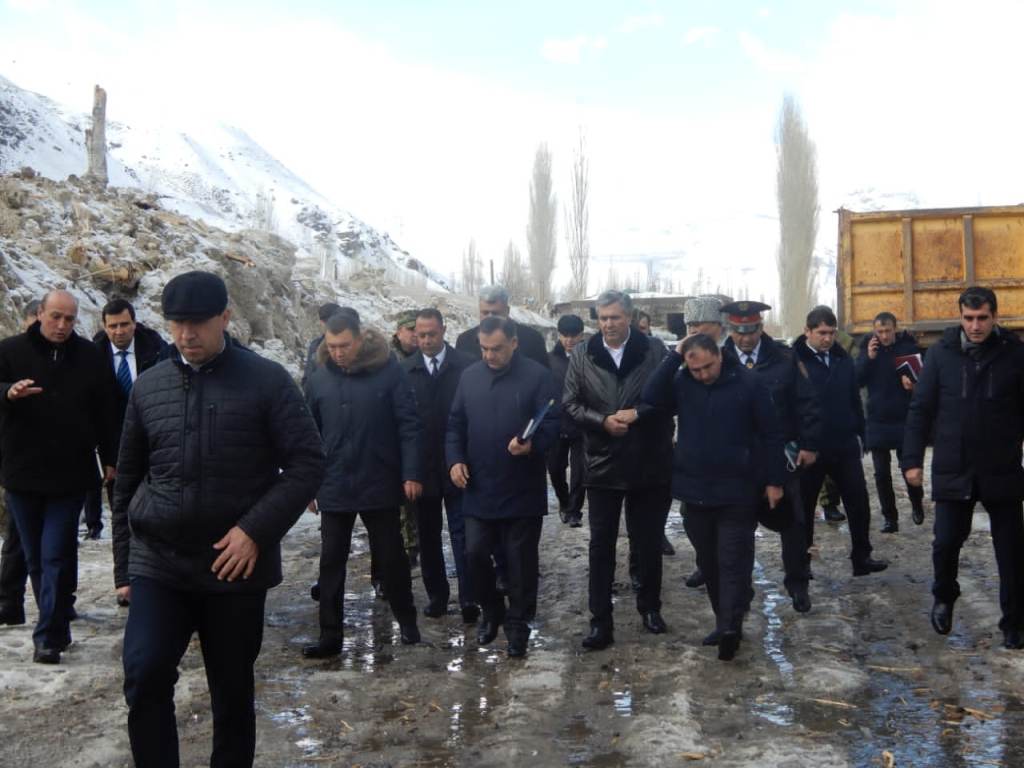
Prime Minister Qohir Rasoulzoda, heading a government delegation, arrived in Khorog, the capital of the Gorno Badakhshan Autonomous Region (GBAO), on February 20, according to the Emergencies Committee under the Government of Tajikistan.
Ms. Umeda Yusufi, a spokeswoman for the Emergencies Committee, says the delegation members include the Security Council Secretary Nasrullo Mahmoudzoda, the Emergencies Committee Chairman Rustam Nazarzoda and Minister of Industry and New Technologies Sherali Kabir, who is Government’s Representative in GBAO’s capital, Khorog.
According to her, the delegation members have got acquainted with the progress of work to eliminate the avalanche consequences.
After getting acquainted with the progress of the work, the prime minister instructed relevant bodies and agencies to complete the construction of houses for those left homeless.
The delegation members reportedly also visited in a hospital people injured by the February 15 avalanche.
They also met with Khorog residents and handed over aid to all those who had been hit by the avalanche, Ms. Yusufi added.
Recall, avalanches in the GBAO claimed at least 18 lives as of the morning of February 18, including 15 in Khorog, one in Shugnan district and two in Vanj district. The dead reportedly are known to include two children, three schoolchildren and nine students.
According to the Emergencies Committee spokeswoman, 44 avalanches came down in territories of Darvoz, Vanj, Rushan, Shugnan, Roshtqala and Ishkashim districts of the GBAO on February 16 alone.
Avalanche risk has led to the closure of roads from GBAO’s capital, Khorog, to Dushanbe and GBAO’s districts of Roshtqala, Ishkashim and Murgab. Work on clearing the roads of the snow is under way.
Umeda Yusufi says the Dushanbe-Khorog highway and the road connecting Khorog and Ishkashim district are still closed for traffic.
Mountains cover 93 percent of Tajikistan’s territory, and avalanches and mudslides kill dozens of people every year.
The Emergencies Committee warns that warmer temperatures have increased the risk of further avalanches in the country and advises people not to travel to mountain areas unnecessarily.