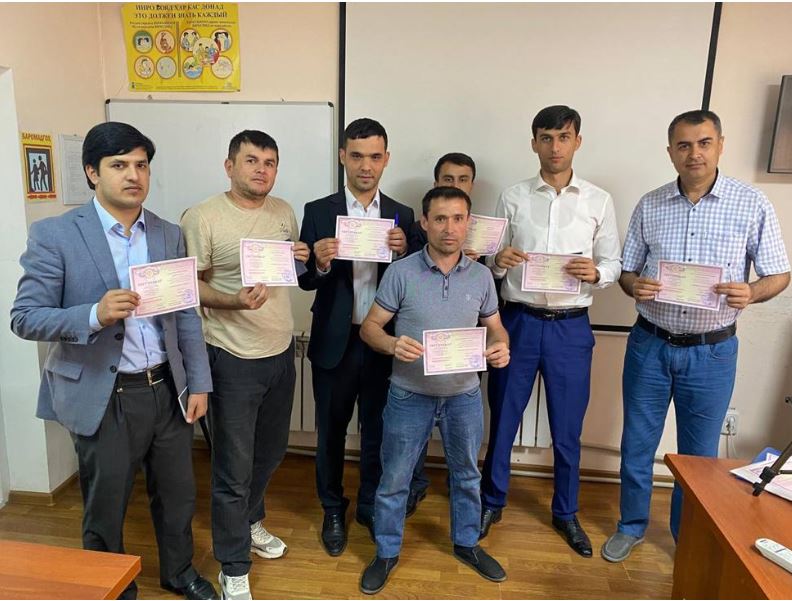
Examination of potential migrant workers in the Russian language has begun in Dushanbe.
Labor migrants have been passing the Russian language test at the Center for Pre-departure Counseling and Training of Labor Migrants, the Migration Service of the Ministry of Labor, Migration and employment of the Population (MoLMEP) since May 29.
The certificate of knowledge of the Russian language is needed to obtain a patent, a temporary residence permit and a residence permit.
An official source at a MoLMEP says that the validity period of the certificate of knowledge of the Russian language for obtaining a patent is three years and the certificate fee is equal to 1,500 Russian rubles (payment is made in the somoni at the rate on the day of the test).
The certificate fees for obtaining a temporary residence permit and a residence permit are perpetual and equal to 2,000 Russian rubles each.
“The Russian language test results are sent for consideration to the St. Petersburg State University, and only from there, based on the results obtained, the certificates will be sent to Dushanbe,” the source added.
Recall, Russian officials propose fining migrant workers with poor Russian language skills. Experts consider that the proposal is the latest twist in public anti-immigrant xenophobia.
In their latest attempt at stigmatizing migrants who go to Russia in search of better job opportunities, high-ranking Russian officials have proposed fining those who do not speak fluent Russian.
Thus, Mrs. Valentina Kazakova, Director of the Main Directorate for Migration Affairs at the Russian Interior Ministry, said on March 23 that the government must collect fines from foreign migrant workers with a low Russian "language rating".
The announcement was made during a roundtable discussion at the Russian State Duma.
The government, if it enacts the rating system, wants to give migrant workers "an adjustment period — for example, one to three months after the migrant worker receives his [or her] ID card", for overcoming any linguistic deficiencies, Kazakova said.
Meanwhile, Uzbek-born human rights activist Valentian Chupik says this proposal is the latest twist in public anti-immigrant xenophobia.
According to her, its goal is to divert public attention away from real problems and cultivate hatred toward "dumb, uneducated non-Russians."
To receive a work permit, migrant workers must pass a test that covers Russian language and history and the foundations of Russian law.