Tajik MFA information department says the global initiative of the Tajik President Emomali Rahmon to declare 2025 the “International Year of Glaciers' Preservation”, adopted at the 77th session of the UN General Assembly, attracts the attention of the scientific and research community of European countries, and due to consequences of rapid melting of glaciers scientists and glaciologists are interested in joint cooperation to study this process.
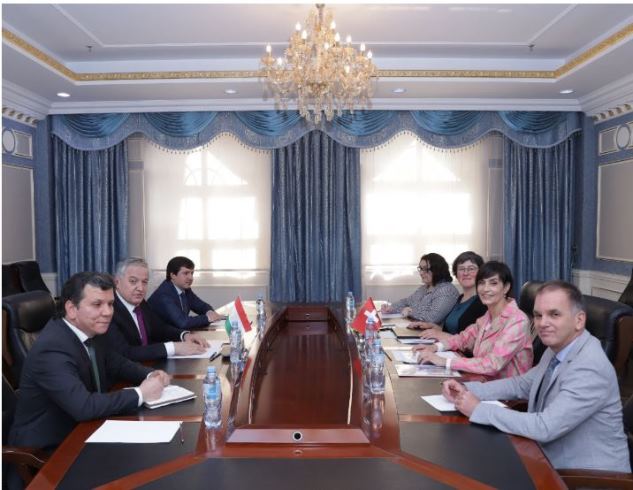
This issues was reportedly discussed on June 1 during the meeting of the Minister of Foreign Affairs of Tajikistan Sirojiddin Muhriddin with scientists and glaciologists of famous scientific research institutes of the Swiss Confederation, who intend to conduct a comprehensive study of processes and factors of glacier melting and possible impact of these undesirable phenomena on the example of glaciers of Tajikistan.
In connection with the celebration of the International Year of Glaciers' Preservation in 2025 and Tajikistan's preparations for the International Conference on Glaciers' Preservation, Sirojiddin Muhriddin considered the actions of Swiss glaciologists and their research results important.
Taking into account the importance of protecting glaciers as the main source of drinking water for the entire region, Muhriddin expressed the country's willingness to expand research cooperation between Tajikistan and the Swiss Confederation.
Tajikistan is one of the most vulnerable countries in terms of climate in the entire region of Europe and Central Asia (ECA). 93% of Tajikistan's territory consists of mountains. For every inhabitant of the country, there are only 0.06 hectares of irrigated land. Tajikistan is highly vulnerable to shocks caused by climate change, such as droughts, floods, landslides, etc. It is assumed that by 2050 up to one third of the glaciers in Central Asia will completely disappear, which will dramatically increase the risk of flash floods from the breakout of glacial lakes.
According to experts, there are more than 13,000 glaciers in Tajikistan. Their total volume is 850 cubic kilometers. The Fedchenko Glacier has shrunk by more than two cubic kilometers of ice over the past few years, with a total volume of 144 km3. It should be noted that a significant part of the water resources of Central Asia is concentrated in Tajikistan. Thus, the melting of glaciers in this country poses a huge threat to the entire region as a whole.
Taking into account the severe consequences of this process, the Tajik President Emomali Rahmon, delivering a statement at a high–level Panel on Water and Climate Issues, proposed to declare 2025 the International Year of Glacier Protection and to determine the date of the World Glacier Protection Day. Another proposal of Tajikistan is the creation of a special International fund for the Protection of Glaciers.