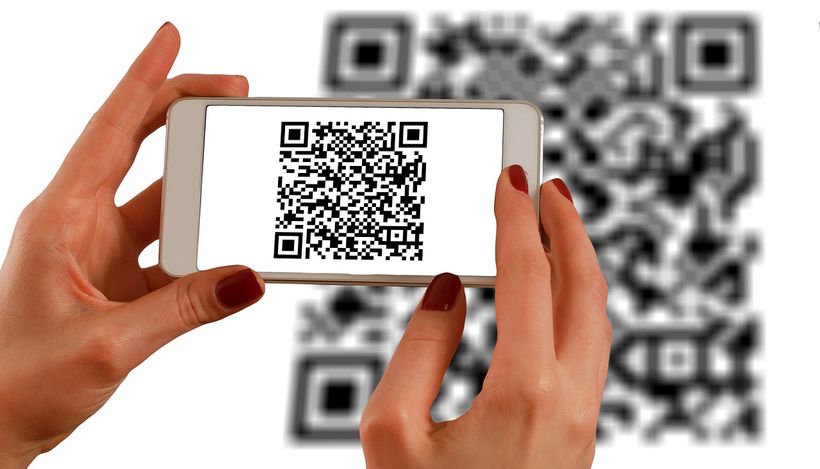
To-date, a single Quick Response (QR) code (a type of barcode that can be read easily by a digital device and which stores information as a series of pixels in a square-shaped grid) has been introduced in some stored in Dushanbe.
Behzod Kamolov, an IT specialist at Alif Bank, says the process of introducing the single QR code in all stores in Dushanbe was supposed to be completed on July 1, 2023.
“By this date, the majority of financial institutions have integrated into the new system and replaced plates with QR codes with a single format,” said Kamolov. “Alif Bank has not did not had time to replace all the plates with QR codes by the set date because it has a large number of serviced outlets. To-date, the plates have been replaced in 70 percent of Dushanbe-based stores.”
Thus, they have reportedly already installed the single QR codes in Merve Restaurant, Diyor Mall, a chain of Food Master’s stores (SFC, Sait Efendi, Alladin, Roll House, Shawarmamaster), he added.
According to him, they plan to replace the remaining plates by the end of this month.
Kamolov further noted that Alif Bank jointly with the Micro Credit Deposit Organization Humo and the National Bank of Tajikistan (NBT) began work on development of the project on introducing the single QR code in 2021.
“The pilot launch of this project took place on December 1, 2022. We conducted testing, which was successfully completed in February this year, and mass installation of the single QR codes began in March.”
According to data from Tajikistan’s financial regulator, about 20,000 QR codes have been installed at stores and service facilities across the country by the beginning of the second quarter of this year, which is reportedly 6,400, or 58 percent more than in the same period last year.
A QR code (quick-response code) is a type of two-dimensional matrix barcode, invented in 1994, by Japanese company Denso Wave for labelling automobile parts. A barcode is a machine-readable optical image that contains information specific to the labelled item. In practice, QR codes contain data for a locator, an identifier, and a website visitor tracking. To efficiently store data, QR codes use four standardized modes of encoding (i) numeric, (ii) alphanumeric, (iii) byte or binary, and (iv) kanji.
A QR code consists of black squares arranged in a square grid on a white background, including some fiducial markers, which can be read by an imaging device such as a camera, and processed using Reed–Solomon error correction until the image can be appropriately interpreted. The required data is then extracted from patterns that are present in both horizontal and vertical components of the image.
The QR labelling system was applied beyond the automobile industry due to its fast readability and greater storage capacity compared to standard UPC barcodes. Applications include product tracking, item identification, time tracking, document management, and general marketing.
As of 2023, QR codes are used in a much broader context, including both commercial tracking applications and convenience-oriented applications aimed at mobile-phone users (termed mobile tagging).
The Universal QR Code stores all of your ticket and product purchases under one single QR code, including memberships, and is unique to your own account.