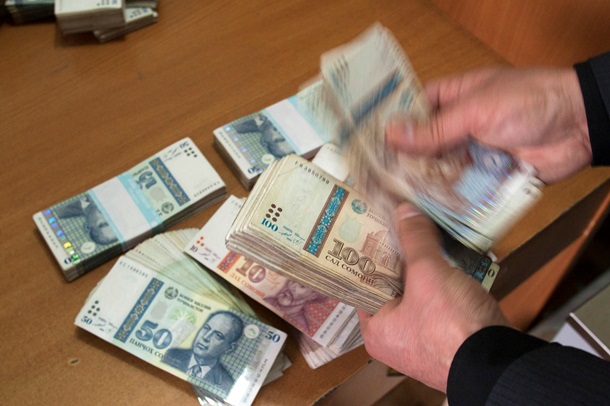
The Russian ruble (RR) continues going up against the Tajik national currency, the somoni (TJS), after the Russian authorities re-imposed currency controls in early October.
According to data from the National Bank of Tajikistan (NBT), the ruble became 3.35 percent stronger against the somoni, increasing from 1:0.1192 on November 1 to 1:0.1232 on November 16.
In exchange offices of some commercial banks of Tajikistan, the exchange rate of RR against TJS is lower than the official rate set by the country’s financial regulator.
Thus, in Amonatbonk (Tajikistan’s savings bank), the RR/TJS buying exchange rate (the rate at which money dealers buy foreign currency) is 1:0.116 and the RR/TJS selling exchange rate (the rate at which money dealers sell foreign currency) is 1:0.118.
However, an average RR/TJS exchange rate in exchange offices of Tajikistan’s commercial banks increased from 1:0.118 on November 1 to 1:0.124 on November 16 (5.0-percent increase).
Meanwhile, the exchange rates of the US dollars (USD) and euro (EUR) against the somoni have changed insignificantly.
The official USD/TJ exchange rate has increased from 1:9527 on November 1 to 1:10.9546, and the official EUR/TJS exchange rate has increased from 1:11.6757 on November 1 to 1:11.9 on November 16.
In exchange offices of the country’s commercial banks, an average USD/TJS exchange rate increased from 1:10.9546 on November 1 to 1:10.96 on November 16, and an average EUR/TJS exchange rate
In the Russian Federation, the current average exchange rate of the ruble against the dollar is 89.465:1.
Recall, Russia on October 3 re-imposed some of the capital controls it introduced in the wake of its full-scale invasion of Ukraine in a new attempt to prop up the ruble as the cost of war weighs heavily on the economy. Russia’s financial regulator, Rosfinmonitoring, monitors and enforces the new requirements on 43 companies in the energy, metals, grain and other sectors.
The Russian authorities said the main purpose of these measures is to create long-term conditions for increasing the transparency and predictability of the currency market, [and] to reduce the opportunity for currency speculation. On October 23, the price for Brent crude oil, a global benchmark for Russia's main export, was 90.17 US dollars per barrel. The ruble has endured a turbulent period since Russia's invasion of Ukraine in February 2022, plunging to a record low of 120 to the dollar in March 2022 before roaring to a seven-year high just a few months later, buoyed by the central bank's capital control measures and a spike in export revenue.