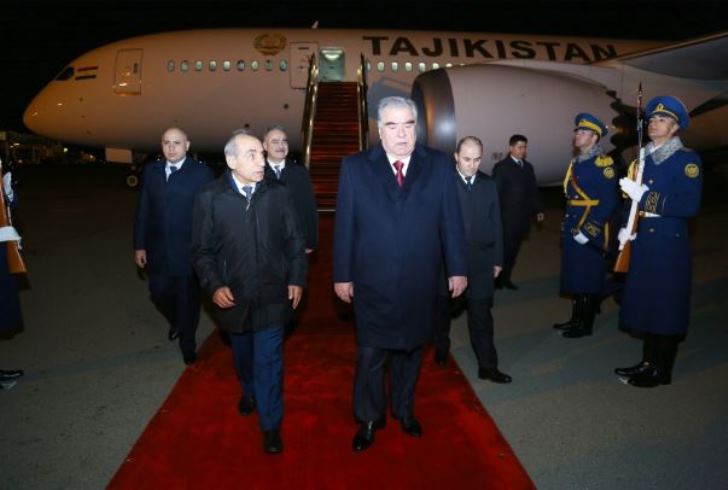
On November 23, President Emomali Rahmon left Belarusian capital, Minsk, for Azerbaijan’s capital, Baku, to participate in the Summit the UN Special Programme for the Economies of Central Asia (SPECA), which is taking place there today within the SPECA Week.
The summit that is dedicated to the 25th anniversary of the Programme is expected to play an important role in strengthening cooperation within the Programme against the background of regional and international challenges.
Meanwhile, the 18th session of the SPECA Governing Council has been held in Baku as part of the SPECA Week. The decisions of the Governing Council, the final document of the Economic Forum and the changes to the Charter were adopted. A plan for the working groups of the Programme for 2024-2025 was approved at the session. Tajikistan was elected the next chairing country of SPECA.
The United Nations Special Programme for the Economies of Central Asia (SPECA: Afghanistan, Azerbaijan, Kazakhstan, Kyrgyzstan, Tajikistan, Turkmenistan and Uzbekistan) aims to strengthen sub-regional cooperation in Central Asia and its integration into the world economy.
The main objective of SPECA is to promote the development of economic interconnections in the region, integrate member countries into the world economy, and provide a platform for cross-border co-operation to achieve the UN Sustainable Development Goals (SDGs).
The supreme management body of SPECA is the Governing Council, composed of national focal points at the ministerial or vice-ministerial level, and the Executive Secretaries of the UN Economic Commission for Europe (ECE) and the Economic and Social Commission for Asia and the Pacific (ESCAP). It provides overall policy guidance to the work carried out within the SPECA framework, oversees the work of the SPECA Project Working Groups, takes stock of progress achieved, identifies priorities for the future and approves the SPECA work plans.
The Steering Board is chaired by one of the SPECA participating countries. The chair country is elected annually on a rotating basis, usually for a one-year term. Decisions are taken by consensus.
The SPECA Economic Forum is organized annually and focuses on selected strategic issues of economic development and cooperation in the region that contribute to the achievement of the SDGs. The Forum serves as a platform for high-level policy dialogue among all stakeholders and produces concrete recommendations for the SPECA Governing Council.