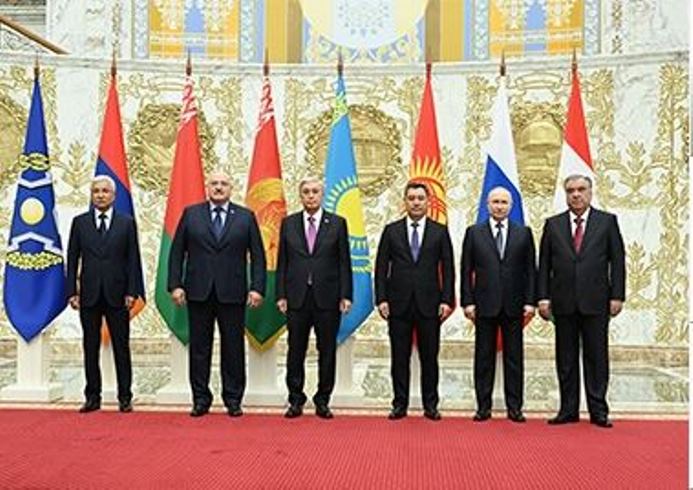
Leaders of the Collective Security Treaty Organization (CSTO) member nations discussed urgent problems of international and regional security at a summit in Minsk on November 23. The summit was notable for the absence of a representative from Armenia.
Hosted by Belarusian President Aleksandr Lukashenko, the meeting was attended by Kyrgyz President Sadyr Japarov, Kazakh President Kassym-Jomart Tokayev, Tajik President Emomali Rahmon, and Russian President Vladimir Putin.
Meanwhile, Belarusian Foreign Minister Sergei Aleinik acknowledged before the summit started that Armenia's absence meant the lack of a quorum, but he told journalists that all the decisions approved would be “absolutely legitimate.”
According to Radio Liberty, he said he had discussed issues and mechanisms for approving decisions with Armenian Foreign Minister Ararat Mirzoyan in a phone call. Aleinik said that according to the CSTO rules, all decisions are made in consultation with all countries.
“We agreed that after the summit, the secretary-general of the CSTO will visit Yerevan. And, of course, we will pass all the decisions that were finalized here as part of the conciliation commission to our Armenian partners. And we will count on them to join us," Aleinik said.
The Kremlin said it "regretted" Armenia's decision to skip the summit amid concerns that Yerevan could pull out of the alliance.
It is not the first time the Armenian leader refused to take part in integration events. In October Armenian Prime Minister Nikol Pashinyan missed the CIS summit in Bishkek.
Armenian Deputy Foreign Minister Mnatsakan Safaryan told reporters in Yerevan earlier on November 23 that Armenia was not considering quitting Russian-led alliances, including the CSTO.
Meanwhile, Belarus.by reports that as a result of the talks the parties approved and signed about 20 documents on politics and defense as well as the counteraction of modern challenges and threats to security.
In particular, the foreign ministers of the CSTO member nations passed a statement on common approaches to ensuring the security of the Eurasian space. Apart from that, the Committee of Secretaries of Security Councils signed a joint resolution on a list of the additional measures the CSTO member states will implement to ensure information security of the organization.
BelTA says a total of 15 documents were submitted for signing.
The CSTO Collective Security Council reportedly signed a declaration, which is designed to emphasize fundamental principles of the organization's operation. The document expresses the organization's stance on topical international security problems.
A decision on measures to develop the Collective Security Treaty Organization's crisis response system was made. A new revision was adopted of the regulation on the procedure for making and implementing collective decisions on using forces and assets of the CSTO collective security system.
The CSTO Collective Security Council also approved a regulation on the joint press center of the Collective Security Treaty Organization.
Decisions on a number of personnel matters were signed. Colonel-General Andrei Serdyukov of Russia was appointed Chief of the CSTO Joint Staff. A decision was made on distributing quota-based jobs in the organization for the next three-year period.
The structure of the CSTO Joint Staff has been adjusted for the sake of improving the performance of working bodies of the organization as they deal with current tasks and new ones.
The heads of state also discussed matters concerning the enhancement and development of military cooperation of the Collective Security Treaty Organization and the organization's budget.
They decided that presidency over the Collective Security Treaty Organization will pass from Belarus to Kazakhstan as from 1 January 2024. During the expanded-participation session of the CSTO Collective Security Council the Kazakhstan president presented information about Kazakhstan's priorities during the presidency.
The next session of the CSTO Collective Security Council will take place in Kazakhstan’s capital, Astana, in the fourth quarter of 2024.
The Collective Security Treaty Organization includes Russia, Armenia, Belarus, Kazakhstan, Kyrgyzstan and Tajikistan.