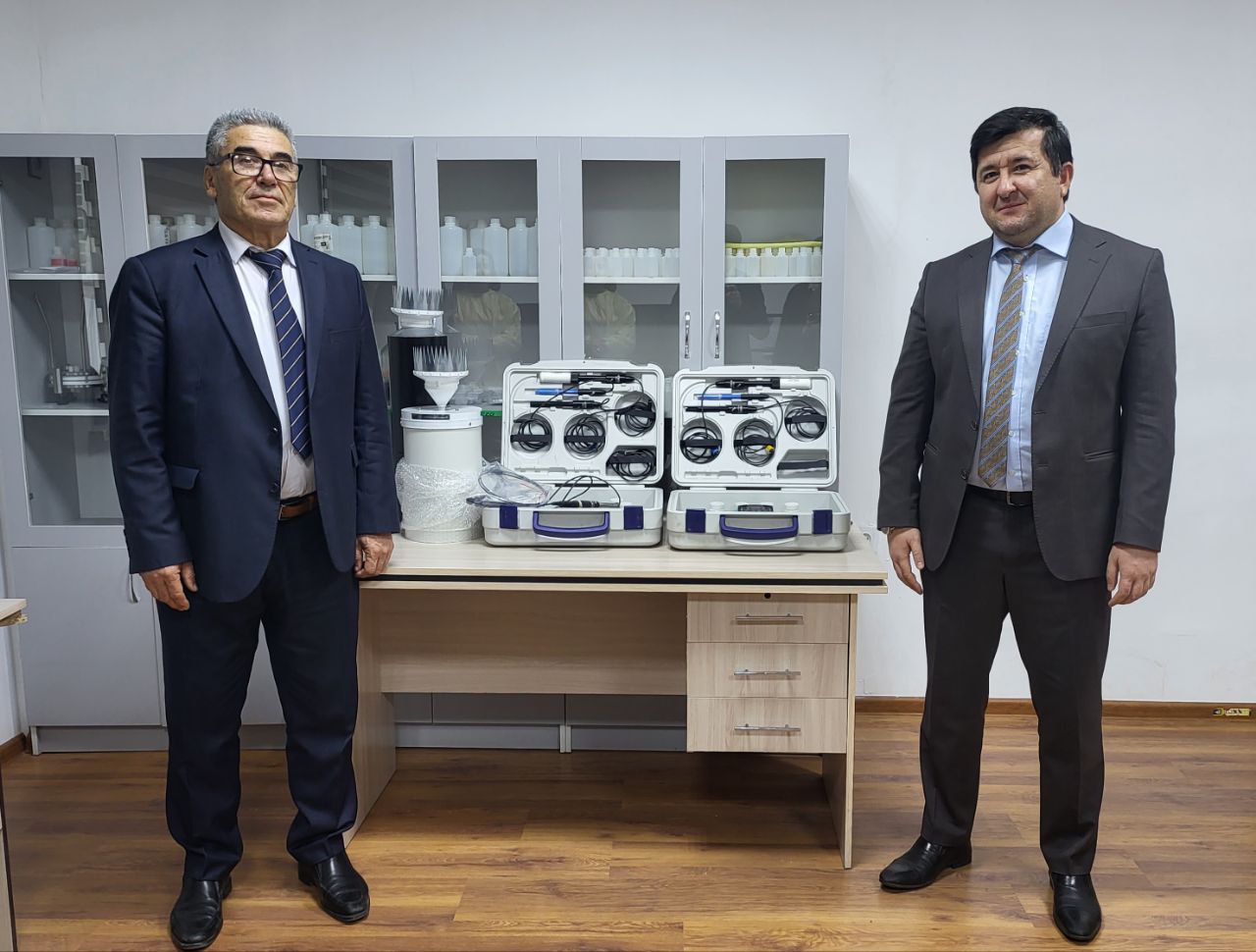
The Glacier Research Center of the National Academy of Sciences of Tajikistan has received new equipment from International Atomic Energy Agency (IAEA) for studying glaciers in field conditions.
Press release issued by the Glacier Research Center notes that “thanks to the declaration of 2025 as the International Year of Glaciers' Preservation, the expansion of international cooperation allows expanding the boundaries of work on studying glaciers.”
2023 is reportedly a significant year for the work of researchers at the Glacier Research Center, namely the Center’s Laboratory of Water Quality, Isotopes and Sanitation.
As part of implementation of the IAEA national project TAD7004, Establishing National Capacity for Glacier and Snow Assessment under Changing Climate Conditions, Mr. Ilhom Mirsaidzoda, Director of the Nuclear and Radiation Safety Agency (NRSA) under the National Academy of Science of. Tajikistan, handed over two sets of multi-parameter digital device MultiLine Multi 3630 to Professor Abdluhamid Qayumov, Director of the Glacier Research Center.
Tajikistan has the highest percentage of mountainous areas in the region, occupying 93% of the country. More than half of Tajikistan’s mountains are at elevations of 3,000 meters or higher. Data from 1940 to 2020 show that temperatures in most areas of the country, including low-altitude (up to 1,000 meters above sea level), mountainous (1,000-2,500 meters above sea level) and high-altitude (above 2,500 meters above sea level) have increased, but the extent of warming varies depending on geographic location and climatic factors.
For each decade of the period 1940-2020 there was an increase in temperature by 0.1ºC -0.2ºC. The number of days with a temperature of 40ºC or higher is increasing. Mountain areas experienced a temperature increase of 0.3ºC-0.5ºC. Fall temperatures in all mountain areas were 0.6ºC-1.1ºC above average.
Decreasing glacier mass is one of the most obvious indicators of atmospheric warming in the world. Monitoring of these changes is one of the main goals of the international strategy developed by the Global Climate Observing System. Long-term measurements of glacier mass balance are the basis for calibrating and validating models that simulate future ice sheet runoff.
This is very important not only for Central Asia, which is one of the most arid continental regions of the northern hemisphere, but for the entire globe.