



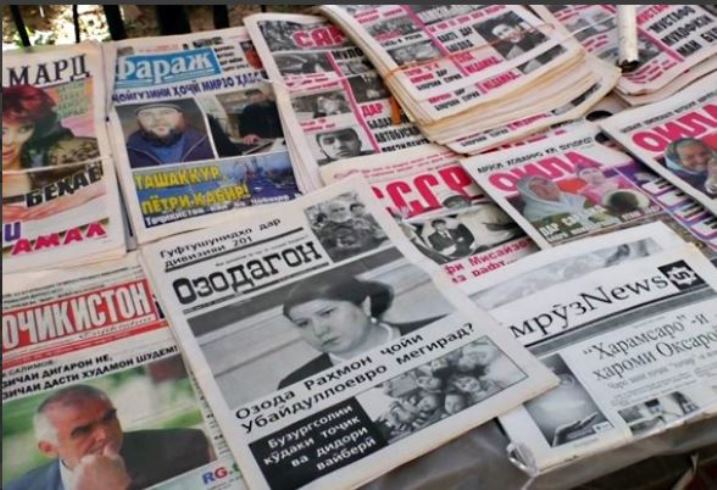
More than a decade ago, Tajikistan’s media environment was relatively diverse and allowed for some criticism and debate, while now, Tajikistan’s media are in their worst state since the violent years of the civil war, journalists told a Committee to Protect Journalists (CPJ)s’ representative during a visit to the country late last year and through messaging apps, says a statement released by CPJ on January 4.
The statement notes that seven journalists were sentenced to lengthy prison terms in retaliation for their work in 2022 and 2023. The United Nations Human Rights Council has criticized “the apparent use of anti-terrorism legislation to silence critical voices” and expressed concern about reports alleging that torture was used to obtain false confessions from prisoners.
In one telling sign of the climate of fear that prevails in Tajikistan, only two among the more than a dozen journalists, press freedom advocates, and experts that CPJ met with were willing to speak on the record, according to the statement.
Prior to 2022, Tajikistan rarely jailed journalists. “For the president [Rahmon], it was important to be able to say we don’t touch journalists,” one local journalist told CPJ.
That changed with the unprecedentedly harsh sentences meted out to the seven convicted in 2022 and 2023 on what are widely seen as charges in retaliation for their work.
The statement notes Asia-Plus has been forced to moderate its content, reducing its political coverage, following a May 2022 threat from authorities to shutter its operations.
A handful of other outlets either avoid political topics entirely, struggle to maintain independence in the face of government repression, or barely function due to lack of funding, multiple sources said. Adding to challenges for journalists are less visible forms of pressure, such as threats of tax fines and surveillance of their work.
The year 2022 had a “devastating” effect on Tajikistan’s already embattled independent media, one journalist said, according to CPJ.
Above all, interviewees said, 2022 entrenched a climate of fear and exacerbated already high levels of self-censorship among journalists.
Several journalists told CPJ they themselves self-censored more following the events of 2022, which had left increasing uncertainty over “red lines,” the topics that are off limits.
The events of 2022 also deepened the sense of alienation between independent journalists and authorities and the public. Where 10 to 15 years ago authorities were forced to reckon with independent media as “a real public watchdog,” noted one analyst, officials now engage less and less with the media, rejecting or ignoring their information requests. Access to information reportedly remains an urgent problem of Tajik journalism.







