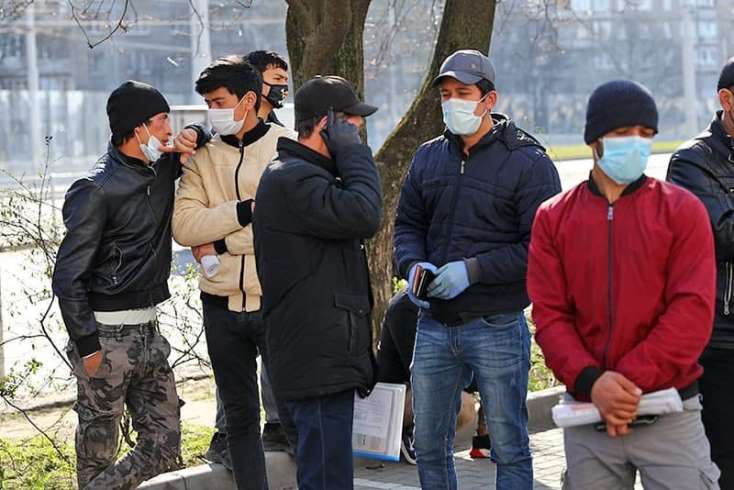
In the days since four Tajikistani citizens were arrested in connection with the March 22 terrorist attack at a Krasnogorsk concert hall, people with Central Asian ancestry, already frequent targets of racism in Russia, have been facing a new wave of hatred and aggression.
Meduza says the country’s security forces have begun treating people with “Asian features” with increased suspicion, while some Russian citizens have started refusing to ride with taxi drivers from Tajikistan. According to the Telegram channel Baza, Tajik community leaders have advised diaspora members to avoid going outside at night for their own safety, and employees of a barbershop where one of the alleged terrorists worked for less than three months have received a flood of threats.
Screenshots shared by the Telegram channel Baza reportedly show users calling on people to storm the shop and burn down the homes of its employees. It’s unclear where these messages were left, but they appear to have been posted on an unofficial community page for the barbershop and later deleted, according to Meduza.
On March 24, the barbershop’s official page on the Russian platform VKontakte reportedly posted a message saying that a “wild hatred” had been “unleashed” on the establishment. “The manager and the owner are getting threatening phone calls, and people are leaving bad ratings and writing awful reviews,” read the post. According to the shop’s employees, Muhammadsobir Faizov only worked there for a few weeks before he disappeared and stopped responding to its management. The message was later deleted, and the page is now private.
The barbershop’s director, Yasmina Safiyeva, told journalists that its managers’ phones have been “ringing nonstop” with people calling with threats. “People are calling and wishing for my death. I’m pregnant and I don’t know what to do. I’m afraid to go outside,” she said. Safiyeva reportedly also said the shop’s employees didn’t notice anything unusual about Faizov during his time there.
In Yekaterinburg, according to the local news outlet It’s My City, police have begun conducting routine stops of men with “Asian features,” and the administration of at least one shopping center has asked its tenants for information about store employees from Kazakhstan, Uzbekistan, Tajikistan, Turkmenistan, and Kyrgyzstan.
Additionally, some taxi service users have reportedly been refusing to ride in vehicles with drivers from Tajikistan. Telegram channels and social media pages have published screenshots from taxi apps in which customers tell their assigned drivers to cancel the ride if they are from Tajikistan.
Atovullo, a 35-year-old Tajik living in Moscow, told Eurasianet that his landlord summarily evicted him without explanation immediately after the Crocus attack, which investigators say was perpetrated by a gang of Tajik gunmen. It has always been difficult for people of non-European backgrounds to find apartments in the Russian capital – now it may become almost entirely impossible.
Atovullo reportedly said he has now resolved to return to Tajikistan, mainly because he does not want his young children to be bullied.
The Telegram channel Baza has reported that Tajik community leaders in Russia have been advising diaspora members not to go outside at night and to avoid large public events. At the same time, according to the channel, some employers have asked workers from Tajikistan to provide them with updated personal information, including their passport data and residence.
According to Eurasianet, the Embassy of Tajikistan in Moscow has in a similar vein urged Tajik citizens to refrain from visiting crowded places.
On March 25, Kyrgyzstan’s Foreign Ministry issued a statement warning citizens against traveling to Russia and recommending that citizens currently in Russia keep their documents with them at all times.
The State Duma (Russia’s lower chamber of parliament) member Konstantin Zatulin has said that anybody calling for “pogroms and lynching” in the wake of the terrorist attack should be prosecuted for “provoking destabilization inside the country.” He warned that “dealing with migrants in this way” will “inevitably lead to escalation.”