Tajikistan’s economic growth is projected to decelerate slightly in 2024 and 2025 due to weaker remittances, fiscal space constraints, and subdued global demand for Tajikistan’s major export commodities, says the Asian Development Bank (ADB) report released on April 11.
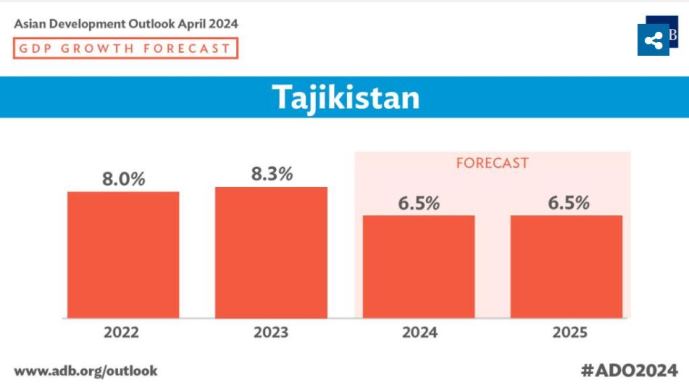
The Asian Development Outlook (ADO) April 2024, the bank’s flagship economic publication, notes that the country’s gross domestic product (GDP) is forecast to grow at 6.5% both this year and next after registering 8.3% growth in 2023.
GDP growth in 2023 was reportedly driven by surges in agriculture and construction, as well as strong growth in services.
“Tajikistan faces significant climate challenges and risks that could lead to irreversible economic, social, and environmental damage,” said ADB Country Director for Tajikistan Shanny Campbell. “Developing a green economy is key for the country’s sustainable growth.”
With a growing population, a shortage of arable land in Tajikistan has created high dependency on imported food, weakening food security and increasing the population’s vulnerability to natural hazards.
The country has lost an estimated 20% of its glaciers in the past 34 years. This poses a major threat to the economy as the country is heavily dependent on glacier-fed rivers for hydropower generation.
With ADB’s support, the government has prepared and approved the Green Economy Development Strategy (GEDS) up to 2027. The strategy outlines 11 priority areas, including energy efficiency, waste management systems, and ecotourism. The government is committed to expanding renewable energy capacity to 10,000 megawatts and achieving universal green electricity generation and net-zero emissions by 2037.
ADO April 2024 calls for Tajikistan to adopt climate-friendly policies and introduce a comprehensive climate fiscal framework to improve planning, budgeting, and the execution of the policies set out in the GEDS. The government may also consider updating its public procurement policies and construction standards by integrating green economy principles.
In 2024 and 2025, inflation in Tajikistan is projected to reach 5.5% and 6.5%, respectively, but currency interventions will mitigate the rise and exchange rate volatility. The increase in inflation is due to anticipated higher lending as deposits increase; a 40% rise in pensions, stipends, and public sector salaries which became effective on 1 January 2024; and a 16% increase in electricity tariffs which also came into being on the first day of this year.
Established in 1966, the Asian Development Bank is owned by 68 members—49 from the region.